
On this RED Friday, the Connecticut Veterans Bulletin (CVB) stands united in unwavering support of our deployed U.S. service members and their families. Across the globe, American military forces are answering the call—upholding liberty, fostering international cooperation, and safeguarding freedom. Whether in the Indo-Pacific, the Middle East, or Europe, these men and women represent the very core of American resolve.
As we wear red today to Remember Everyone Deployed, we turn our attention to three significant deployments that reflect the scope and sacrifice of today’s U.S. military operations. Each movement is a vivid reminder of what our military families endure, and what our service members carry with them—not just gear, but also duty, loyalty, and honor.
From the Green Mountains to the Heart of Europe
On May 27, 2025, the 86th Infantry Brigade Combat Team (Mountain), based out of South Burlington, Vermont, deployed to Europe for Immediate Response 25. This crucial multinational NATO exercise involves more than 12,000 troops across eight European countries. As a part of the larger DEFENDER 25 series, the 86th IBCT’s mission highlights American leadership in collective defense. These Vermont-based soldiers left behind families, careers, and communities to integrate with allies and sharpen readiness in the face of growing threats.
Their presence in the mountainous and complex European terrain demonstrates not only their unique training in mountain warfare but also the indispensable role of the National Guard in global security operations. The 86th’s departure is more than a maneuver—it’s a promise kept to every NATO partner and every American watching from home.
Strategic Deterrence in the Pacific: NMESIS and HIMARS Head to the Philippines
Just one day earlier, on May 26, 2025, U.S. Marines and Army soldiers prepared for the forward deployment of two of America’s most cutting-edge weapon systems: NMESIS (Navy/Marine Expeditionary Ship Interdiction System) and HIMARS (High Mobility Artillery Rocket System). These units are being sent to the Philippine islands as part of KAMANDAG, a joint exercise that deepens cooperation between the U.S. and the Armed Forces of the Philippines.
This deployment is more than a show of force—it’s a demonstration of allied unity, mutual trust, and technological superiority. These troops are tasked with operating in austere island environments and complex geopolitical zones, serving as sentinels for peace through strength. As families across the Pacific send care packages and await messages from their loved ones, CVB salutes every Marine and Soldier committed to protecting vital sea lanes and allied sovereignty.
Naval Readiness in the Middle East: USS Canberra Arrives in Bahrain
Meanwhile, on May 27, 2025, the USS Canberra (LCS 30) arrived in Manama, Bahrain, for a scheduled port visit to U.S. Naval Forces Central Command. A symbol of modern naval agility, the Independence-variant littoral combat ship is part of the USS Theodore Roosevelt Carrier Strike Group operating in the U.S. 5th Fleet. The Canberra’s visit supports maritime security operations, deterring malign influence in one of the world’s most vital maritime transit corridors.
While sailors stand watch in one of the globe’s most geopolitically complex regions, their families at home uphold a different kind of strength—managing life’s challenges with courage, grace, and sacrifice. Their strength anchors the fleet. Their resilience is a national treasure.
Why RED Friday Matters
Every Friday, Americans wear red to say one thing clearly: You are not forgotten. RED Friday is not a slogan—it’s a solemn pledge to our deployed troops and their families. As our forces operate across continents—on mountain trails, island shores, and open seas—we honor not only their missions but also their absence. We acknowledge the birthdays missed, the school events attended via video call, and the strength it takes for a military spouse to manage home front logistics.
Today, RED Friday stands for the 86th IBCT soldiers navigating Europe’s terrain, the Marines and Army artillery teams in the Pacific, and the USS Canberra’s sailors navigating the waters near Bahrain. It stands for every family waiting, worrying, and holding the line.
We remember. We respect. And we wear red for them.
U.S. Deploys NMESIS and HIMARS to Northern Philippines for KAMANDAG 9, Enhancing Regional Deterrence
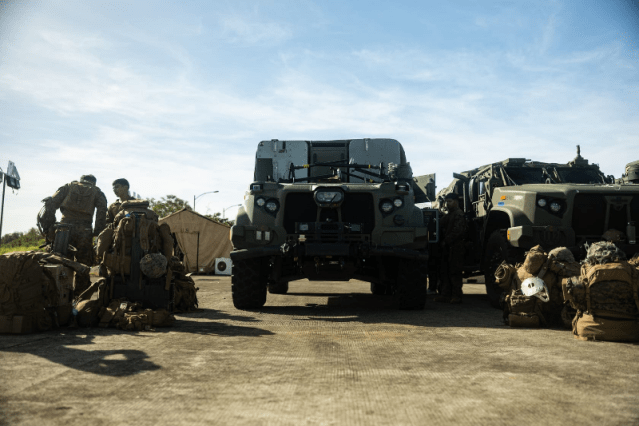
On May 26, 2025, the United States began deploying two of its most advanced missile systems—the Navy-Marine Expeditionary Ship Interdiction System (NMESIS) and the Army’s High Mobility Artillery Rocket System (HIMARS)—to the northern Philippine islands as part of Exercise KAMANDAG 9. The move is part of a larger effort to bolster deterrence, reinforce alliances, and demonstrate combat readiness in one of the most strategically contested areas of the Indo-Pacific.
Strategic Locations: Batanes and Babuyan Islands
The NMESIS units were deployed to Batan Island and Babuyan Island, part of the Luzon Strait and located approximately 120 miles south of Taiwan. These islands form a key chokepoint between the South China Sea and the Philippine Sea, making them an ideal launch point for any coastal defense or ship interdiction strategy.
In parallel, HIMARS launchers were deployed to support locations within the same region, offering a layered and flexible defense capability that could counter both land and maritime threats. This marks one of the most forward-positioned deployments of U.S. missile systems in Southeast Asia to date.
Missile Systems Overview
NMESIS (Navy-Marine Expeditionary Ship Interdiction System)
Developed by the U.S. Marine Corps, NMESIS integrates the Naval Strike Missile (NSM) with a Remotely Operated Ground Unit for Expeditionary Fires (ROGUE-Fires). It is a highly mobile, ground-based system specifically designed to target enemy warships at distances over 100 nautical miles. The system’s autonomous capabilities and firepower make it an essential tool for island-based denial operations.
HIMARS (High Mobility Artillery Rocket System)
HIMARS is a lightweight, highly mobile artillery rocket system operated by the U.S. Army. It can fire the Guided Multiple Launch Rocket System (GMLRS) and the Army Tactical Missile System (ATACMS), providing deep-strike capability with precision. Its ability to rapidly deploy and redeploy makes it ideal for expeditionary environments like the Philippine archipelago.
About KAMANDAG 9
KAMANDAG, which stands for “Kaagapay ng mga Mandirigma ng Dagat” or “Cooperation of Warriors of the Sea,” is an annual bilateral exercise conducted by the U.S. Marine Corps and the Armed Forces of the Philippines. KAMANDAG 9 is the largest and most strategically significant iteration to date, reflecting growing regional threats and evolving military partnerships.
This year’s exercise involves more than 4,000 troops and features live-fire drills, amphibious landings, and joint command-and-control operations. Allied forces from Japan, South Korea, and the United Kingdom are also participating, contributing to the exercise’s multinational character and broad strategic implications.
Regional Context and Strategic Importance
The deployment of NMESIS and HIMARS to islands so close to Taiwan comes at a time of escalating tensions in the South China Sea and Taiwan Strait. These systems provide not just a symbolic show of force, but a very real capability to deny adversary access to contested waters.
U.S. officials have described the deployment as a key part of the Pentagon’s broader “posture realignment” in the Pacific. By strengthening defensive positions in the Philippines, the U.S. ensures it can operate effectively in the First Island Chain and support partners like Japan and Taiwan in the event of a crisis.
Philippine Navy spokesperson Captain John Percie Alcos emphasized the defensive nature of the deployment, stating, “This is part of routine bilateral exercises. It is not directed against any country. The objective is to be able to conduct joint operations with marine corps of allied nations.”
Looking Ahead
The deployment of NMESIS and HIMARS in the Philippines marks a significant turning point in joint U.S.-Philippine military cooperation. It not only advances both nations’ strategic interests, but also sends a clear signal that the United States and its allies are prepared to defend freedom of navigation and territorial integrity in the Indo-Pacific.
As KAMANDAG 9 continues through June 2025, these high-profile systems will be tested in a variety of scenarios, reinforcing regional stability and military readiness in the face of mounting challenges.
USS Canberra (LCS 30) Arrives in Bahrain on May 27, 2025, Enhancing U.S. Navy’s Mine Countermeasure Capabilities in the Middle East
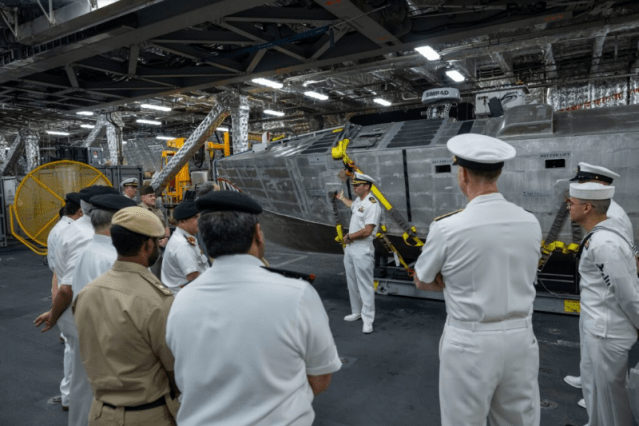
On May 27, 2025, the USS Canberra (LCS 30), an Independence-variant littoral combat ship, arrived in Bahrain, marking a significant milestone in the U.S. Navy’s efforts to bolster maritime security in the Middle East. This deployment introduces advanced mine countermeasure (MCM) capabilities to the region, enhancing the Navy’s operational readiness in critical waterways.
A Historic Commissioning and Deployment
Commissioned on July 22, 2023, at Fleet Base East in Sydney, Australia, the USS Canberra holds the distinction of being the first U.S. Navy warship commissioned in a foreign port. The ceremony underscored the deep-rooted alliance between the United States and Australia, with dignitaries such as U.S. Secretary of the Navy Carlos Del Toro and Australian Deputy Prime Minister Richard Marles in attendance.
Following its commissioning, the USS Canberra departed its homeport of Naval Base San Diego on March 10, 2025, embarking on its maiden deployment equipped with the MCM Mission Package. This deployment is part of the Navy’s strategic initiative to modernize its mine countermeasure operations, transitioning from legacy systems to more advanced, unmanned technologies.
Advanced Mine Countermeasure Capabilities
The MCM Mission Package aboard the USS Canberra represents a significant leap in mine warfare technology. It includes an integrated suite of unmanned systems and sensors designed to detect, classify, and neutralize naval mines while keeping sailors out of harm’s way. Key components of the package include:
- MH-60S Helicopter equipped with the AN/AES-1 Airborne Laser Mine Detection System and the AN/ASQ-235 Airborne Mine Neutralization System
- Unmanned Surface Vessels (USVs) such as the Textron Common Unmanned Surface Vehicle, carrying mine detection and neutralization payloads
- Knifefish Unmanned Undersea Vehicle (UUV) designed for buried minehunting operations
These technologies enable the USS Canberra to conduct comprehensive mine countermeasure operations across various maritime environments, from shallow coastal areas to deeper waters.
Strategic Significance of Bahrain Deployment
Bahrain serves as a pivotal hub for U.S. naval operations in the Middle East, hosting the U.S. Navy’s Fifth Fleet. The arrival of the USS Canberra enhances the fleet’s capabilities in ensuring the safety and security of vital maritime chokepoints, including the Strait of Hormuz and the Bab el-Mandeb Strait.
The deployment also aligns with the objectives of the International Maritime Exercise (IMX) 2025, which concluded in Bahrain on February 20, 2025. IMX 2025 was a U.S.-sponsored naval exercise involving over 5,000 personnel from more than 35 nations, focusing on mine countermeasures, unmanned systems integration, and maritime security operations.
Enhancing Regional Maritime Security
The USS Canberra’s presence in Bahrain signifies a commitment to collaborative maritime security efforts in the region. By integrating advanced MCM capabilities, the ship contributes to safeguarding international shipping lanes against the threat of naval mines, which have been used by non-state actors to disrupt commerce and navigation.
This deployment also reflects the broader strategic emphasis on leveraging unmanned systems and artificial intelligence to enhance situational awareness and operational effectiveness in complex maritime environments.
Conclusion
The USS Canberra’s arrival in Bahrain on May 27, 2025, marks a significant advancement in the U.S. Navy’s mine countermeasure operations in the Middle East. Through the integration of cutting-edge unmanned technologies and international collaboration, the deployment reinforces the Navy’s commitment to maintaining freedom of navigation and maritime security in one of the world’s most strategically important regions.
86th Infantry Brigade Combat Team (Mountain) Deploys to Europe for Immediate Response 25
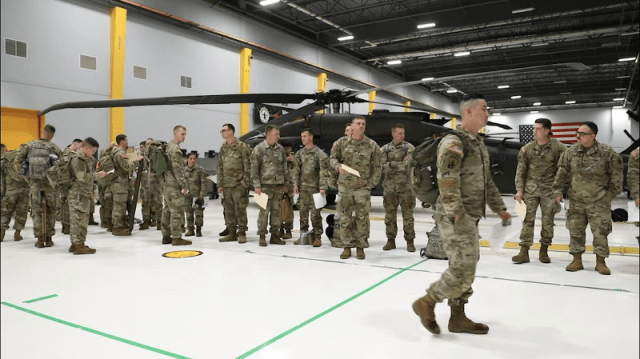
On May 27, 2025, soldiers from the 86th Infantry Brigade Combat Team (Mountain), known as the 86th IBCT (MTN), departed from South Burlington, Vermont, to join Immediate Response 25 (IR-25)—a key multinational training operation under the U.S. Army’s DEFENDER 25 series. This deployment reinforces America’s commitment to NATO readiness and strengthens joint capability with European allies in a time of increasing global security challenges.
Departure from South Burlington
The soldiers embarked from the Army Aviation Support Facility in South Burlington after conducting final preflight checks on May 23, 2025. These inspections, part of the unit’s standard deployment readiness protocol, ensured that all personnel, gear, and mission-critical systems were operational and aligned with the demands of the exercise.
What Is Immediate Response 25?
Immediate Response 25 runs from May 26 to June 9, 2025, and features participation from over 12,000 personnel across eight host countries: Albania, Bulgaria, Croatia, Greece, Kosovo, Montenegro, North Macedonia, and Slovakia. This year’s iteration of the exercise focuses on live-fire artillery, cyber defense, river-crossing operations, and CBRNE (Chemical, Biological, Radiological, Nuclear, and Explosives) preparedness.
Part of the broader DEFENDER 25 initiative, Immediate Response 25 aims to strengthen multinational cooperation, test rapid deployment capabilities, and increase strategic mobility across NATO’s eastern flank. It also provides an opportunity to practice full-spectrum operations under complex and geographically diverse conditions.
Role of the 86th IBCT (MTN)
The 86th IBCT (MTN), often referred to as “The Vermont Brigade,” is uniquely qualified for this mission. A light infantry brigade combat team trained in mountain warfare, it draws from National Guard units across Vermont, Connecticut, Colorado, Massachusetts, New Hampshire, and Maine.
The brigade is currently led by Colonel Frank A. Tantillo, who assumed command in September 2024. Under his leadership, the unit continues its tradition of integrating seamlessly into multinational coalitions and playing a pivotal role in both homeland and international defense operations.
Strategic Implications
The U.S. Army’s continued participation in DEFENDER series exercises like Immediate Response 25 signals an unwavering commitment to NATO and allied deterrence in Eastern Europe. The deployment of the 86th IBCT (MTN) serves not only as a demonstration of U.S. rapid deployment readiness but also as a deterrent posture reinforcing the principle of collective defense.
As geopolitical tensions remain high in various regions, these forward-positioned exercises are more than symbolic—they build real-world interoperability, foster mutual trust among allied forces, and ensure that readiness levels remain high across NATO’s eastern borders.
Discover more from CONNECTICUT VETERANS BULLETIN
Subscribe to get the latest posts sent to your email.
