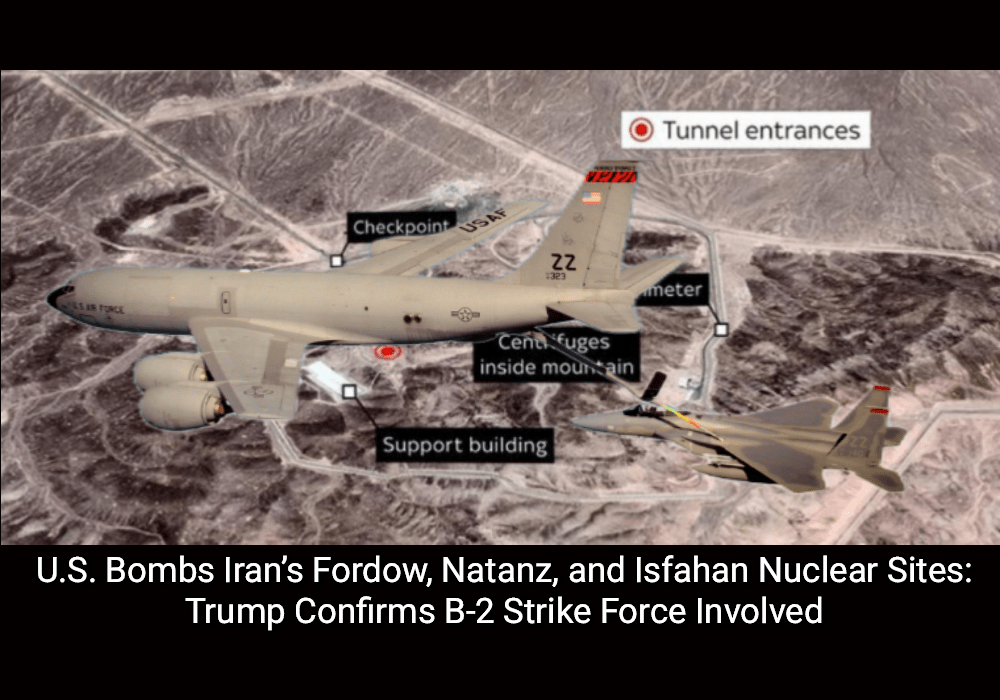
In a dramatic escalation of U.S. involvement in the Israel–Iran conflict, President Donald Trump confirmed that American B‑2 bombers dropped a full payload of precision-guided bunker-busting bombs on Iran’s three most sensitive nuclear facilities: Fordow, Natanz, and Isfahan. The operation, announced on June 22, 2025, represents one of the most aggressive uses of American airpower in the Middle East in over a decade.
“We have completed our very successful attack on the three Nuclear sites in Iran, including Fordow… All planes are safely on their way home,” Trump wrote on Truth Social. “A full payload of BOMBS was dropped on the primary site, Fordow. Congratulations to our great American Warriors. There is not another military in the World that could have done this. NOW IS THE TIME FOR PEACE!”
🔻 PRIMARY TARGET: FORDOW
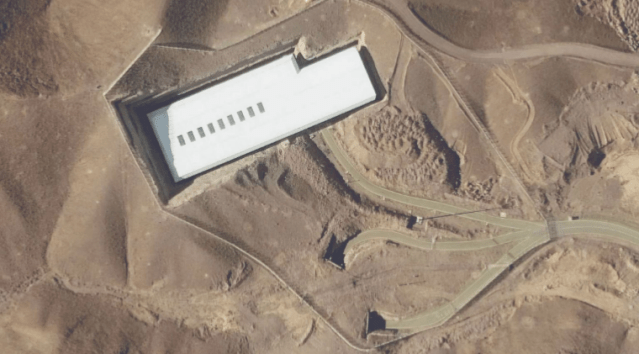
The Fordow Fuel Enrichment Plant, a fortified subterranean nuclear site buried deep inside a mountain near Qom, Iran, was the central target of the mission. Capable of enriching uranium to weapons-grade levels, the site is buried under at least 260 feet of rock and reinforced concrete. Only the GBU-57A/B Massive Ordnance Penetrator (MOP), a 30,000-pound bomb carried exclusively by B‑2 Spirit stealth bombers, is capable of reaching its depths.
The U.S. strike targeted the heart of Iran’s uranium enrichment capability at Fordow, which had long been shielded from potential Israeli-only operations. The B‑2 aircraft, using satellite-guided targeting and escorted by stealth fighter jets, are believed to have inflicted heavy damage on the site’s operational core.
🔻 SECONDARY TARGET: NATANZ
The Natanz nuclear facility, one of Iran’s largest and most well-known enrichment sites, was also struck. Natanz includes a massive underground Fuel Enrichment Plant (FEP) and a Pilot Fuel Enrichment Plant (PFEP) that houses advanced centrifuges.
According to U.S. and Israeli sources, Israeli jets initially damaged above-ground support buildings. U.S. B‑2 bombers then struck the deeper layers with bunker-busters to target centrifuge halls and buried operational zones. Multiple centrifuges were reported destroyed in coordinated airstrikes, severely impacting Iran’s enrichment capabilities.
🔻 THIRD TARGET: ISFAHAN
The Isfahan nuclear site focuses on uranium conversion, fuel plate manufacturing, and production of centrifuge components. It is critical to Iran’s overall nuclear fuel cycle. The site also includes buried infrastructure connected to uranium hexafluoride (UF6) processing.
The Isfahan facility was bombed jointly by Israeli and U.S. forces. Israeli fighter jets carried out initial strikes against surface targets, followed by U.S. precision munitions targeting key underground components. Reports indicate disruption to centrifuge assembly operations and damage to auxiliary processing facilities.
🛫 U.S. MILITARY UNITS INVOLVED
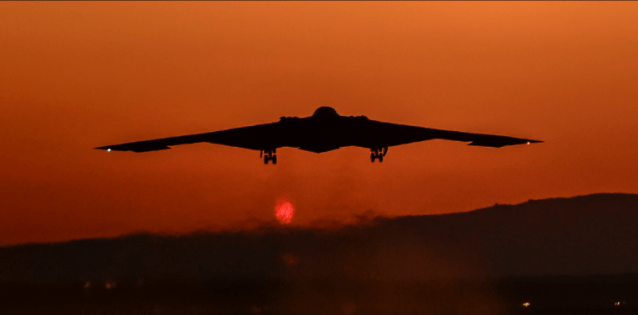
The strikes on Fordow, Natanz, and Isfahan marked the first known use of the GBU‑57A/B MOP in combat since its development. These bombs were delivered by B‑2 Spirit stealth bombers, deployed from Whiteman Air Force Base in Missouri and potentially forward-deployed to Diego Garcia and Andersen AFB in Guam for operational range.
To support the mission, KC‑135 Stratotankers and KC‑46 Pegasus refueling aircraft provided mid-air refueling to extend bomber flight endurance. Several F-22 Raptor and F-35 Lightning II stealth fighter jets flew escort missions, suppressing potential Iranian air defenses and ensuring air superiority.
| Unit | Role |
|---|---|
| B‑2 Spirit bombers | Delivered GBU‑57 bunker-buster bombs to deeply buried sites |
| KC-135 & KC-46 tankers | Provided mid-air refueling for long-range missions |
| F-35/F-22 escorts | Protected bomber assets and suppressed radar threats |
This carefully choreographed strike involved multiple branches of the U.S. Air Force and demonstrated American long-range strike precision. Surveillance and coordination were reportedly managed via U.S. Central Command and forward operations centers in the region.
🧭 STRATEGIC SIGNIFICANCE
Fordow has long been considered the most dangerous component of Iran’s nuclear complex due to its concealment and its capacity to enrich uranium to 60%, close to weapons-grade. Experts note that only the U.S. military had the tools and access to neutralize such a deeply buried target.
Natanz, which has been sabotaged multiple times before by Israel through cyberattacks and explosions, still housed Iran’s most advanced centrifuge halls. The Isfahan facility was also considered vital, as it supports Iran’s conversion process and centrifuge assembly line.
Trump’s statement emphasized U.S. capabilities, stating:
“There is not another military in the World that could have done this.”
He concluded the message with:
“NOW IS THE TIME FOR PEACE!”
While President Trump hailed the operation as a success and a means to peace, Iran’s response was swift. Iranian Foreign Minister Abbas Araghchi called the U.S. involvement “very, very dangerous for everyone,” warning of retaliation. Iranian proxy forces, including Houthi rebels in Yemen, threatened renewed missile strikes on American military assets and ships.
🌍 GLOBAL FALLOUT
The International Atomic Energy Agency (IAEA) confirmed that three Iranian nuclear facilities suffered visible structural damage, though no radioactive leak has been reported so far. The IAEA urged both sides to “cease escalatory military actions” and return to dialogue.
U.S. Central Command stated that all American aircraft safely exited Iranian airspace and returned without casualties. While there are no official reports of civilian deaths, the region remains tense.
Israel has heightened its alert levels along its northern border, preparing for retaliatory action by Iran or Hezbollah. American bases in Iraq, Syria, and the Persian Gulf have also been placed on high alert.
🇺🇸 SUMMARY
The U.S. bombing of Iran’s Fordow, Natanz, and Isfahan nuclear facilities marks a turning point in the Israel–Iran conflict and signals a significant U.S. escalation. The strikes were carried out by B‑2 bombers equipped with the world’s most powerful bunker‑buster bombs, supported by aerial refueling and stealth fighter escorts.
With President Trump confirming the strikes and expressing admiration for U.S. military prowess, the world now watches closely for the next moves in a volatile and deeply uncertain geopolitical landscape. While Trump insists that “NOW IS THE TIME FOR PEACE,” Iran has promised a harsh response, making the aftermath of this strike potentially as consequential as the attack itself.
Discover more from CONNECTICUT VETERANS BULLETIN
Subscribe to get the latest posts sent to your email.
