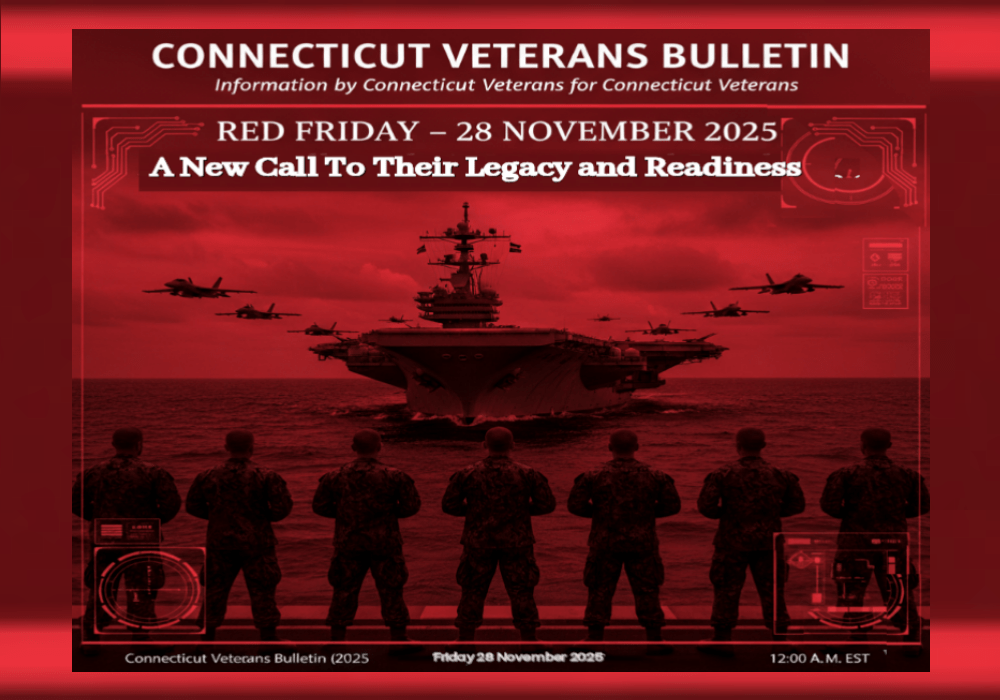
Connecticut Veterans Bulletin (CVB)
Friday 28 November 2025
12:00 A.M. EST
On this RED FRIDAY, we reflect not merely on service done, but on service sustained. From the waters of the Indo-Pacific to the forward positions of the Western Hemisphere, our nation’s military forces are signalling urgency, presence, and intent — the same hallmarks our veterans embodied in earlier eras.
For decades, our veterans kept watch from carrier flight decks, patrol boat bridges, and island bases—often preparing in calm, waiting amidst tension, and standing ready for what might come. Today’s global defence environment demands that same quiet certainty, but at an elevated tempo. The seas are more contested, the stakes higher, and the expectation of rapid action closer to reality.
As a community of veterans, families and supporters, we understand the rhythms of readiness: maintenance cycles, mission briefs, watch rotations, supply lines, and the steady hum of preparation. We also know the toll—of distance from home, of alert nights, of deterring adversaries by presence alone.
On this day, we honour those legacies and look at how that readiness is manifesting now. We spotlight three major developments: a forward-deployed U.S. carrier entering a critical maritime region; a defence-strategy brief that highlights where words meet (or fail to meet) action; and a senior naval leader urging immediate readiness for high-intensity conflict. These events are not remote headlines—they echo the watch-standing, the sacrifice, and the resolve that define our community.
Let this RED FRIDAY issue serve as a reminder: the mission continues, the pattern remains, and the duty of readiness endures. We honour the past by remaining aware of the present. We respect service by acknowledging the stakes. And we uplift the future by supporting those who stand ready now.
USS George Washington Enters the South China Sea
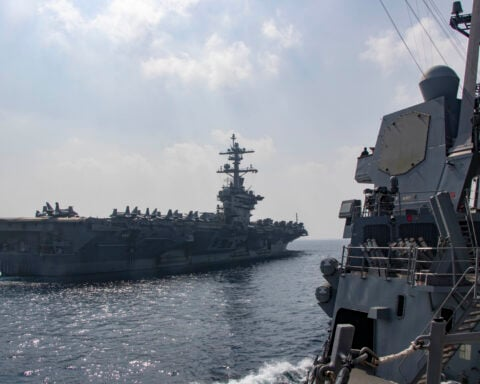
On 17 November 2025, the nuclear-powered aircraft carrier USS George Washington (CVN-73) transited the Luzon Strait and entered the contested waters of the South China Sea. Operating out of Yokosuka, Japan, the carrier is the only U.S. aircraft carrier forward-deployed overseas, and its arrival in the region marked a clear demonstration of sustained maritime power during a period of elevated tension.
Strategic Significance
This deployment came on the heels of operations by the USS Nimitz (CVN-68), which had conducted joint exercises with Japanese and Philippine naval and coast-guard forces near Scarborough Shoal, and had also been involved in recovery operations after recent aircraft incidents. The timing signalled a deliberate relief or augmentation by the George Washington strike group.
The presence of a U.S. carrier strike group in these waters carries multiple strategic dimensions:
- Assurance of allies. The Philippines and Japan, bound by mutual security treaties with the U.S., observed a tangible sign that Washington remains engaged and capable of projecting power in the region.
- Deterrence of coercion. With Beijing’s expansive maritime claims and aggressive posturing inside the first island chain, the forward deployment reinforced the message that freedom of navigation and allied access will be defended.
- Persistence over episodic deployment. Whereas past carrier visits to the region might have been short-term showings, the strike group’s reported conduct—including deactivation of civilian AIS transponders for over 50 days—suggests a sustained operational posture rather than one-off presence.
Operational Dimensions
Operationally, the strike group is expected to conduct flight-deck operations, integration with allied forces, and maritime domain awareness in an environment where Chinese maritime, air, and missile capabilities are growing rapidly. Satellite imagery tracked the George Washington moving into waters west of Palawan province, Philippines, which places the carrier within a strategic intersection of the first island chain and contested features of the South China Sea.
The environment is complicated: just months earlier the U.S. Navy lost an F/A-18F Super Hornet and an MH-60R Sea Hawk in the region during operations from the Nimitz strike group. While those losses did not involve the George Washington directly, they illustrate the operational risk environment in which U.S. carriers now operate.
Implications for Veterans and the Navy Community
For veterans and the CVB audience, this deployment echoes many of the attributes you know intimately: forward basing, persistent presence, deterrence through readiness, and operational risk accepted in service of strategic stability. The seas you once watched remain central to global commerce and security, and the carriers you supported continue the lineage of power projection.
As the George Washington operates amid an evolving maritime competition, it reinforces the message that readiness today is as vital as it ever was during the Cold War, yet the theatre now has changed. Distribution of forces, rapid surge expectations, integration with unmanned systems and allied partners—all feature prominently. The veteran community can draw straight lines from its service to the demands of this new era.
The D Brief: ‘Peace-Plan’ Pushback and Words vs Actions off Venezuela
On 24 November 2025, the newsletter The D Brief, published by Defence One, released an incisive analysis banner-titled “‘Peace plan’ pushback; Words vs. actions off Venezuela; Army’s most tech-forward division; CNO on ship-building; And a bit more.” Among the key take-aways, two strands stood out: first, resistance from Ukraine to proposed diplomatic settlement plans; second, the disparity between U.S. public rhetoric on Venezuela and the observable operational follow-through offshore.
Ukraine: Dynamics of Diplomatic Friction
According to the briefing, while U.S. and allied officials have floated proposals for a diplomatic settlement to the war in Ukraine, Kyiv’s leaders remain sceptical. They view certain frameworks as prematurely locking in concessions or limiting Ukraine’s negotiating leverage. This push-back reveals a broader tension: strategic urgency versus political and operational feasibility. The veterans’ community understands how strategy must align with capability, and here the alignment appears unresolved.
Venezuela: Credibility Gap in the Western Hemisphere
The briefing noted that although U.S. officials continue to declare support for democracy and regulatory pressure on Venezuela’s regime, the visible operational engagement offshore remains limited. The mismatch between declared policy and measurable action raises questions about deterrence credibility in a region already fraught with instability. For veterans who served in Latin American or adjacent theatres, the lesson resonates: presence, posture and follow-through matter as much as the words issued from headquarters.
Force Modernisation and Institutional Constraints
Beyond diplomacy and policy, The D Brief also spotlighted an Army division implementing next-generation integration (sensors, AI, unmanned systems) and examined persistent constraints in naval ship-building—long lead times, industrial-base bottlenecks, funding unpredictability. These institutional realities echo the readiness challenges veterans faced and continue to face within the modern force.
Why This Matters to the CVB Audience
For the veterans, families and supporters reading CVB, this briefing highlights the strategic continuity you know: deterrence isn’t just about weapons, it’s about coherence between intent, message and deployment. The games of diplomacy, theatre and forward stationing have not disappeared—they have evolved. The pressures highlighted by The D Brief reflect how today’s forces must operate within a global environment of competing demands and compressed timelines.
CNO Caudle Tells Sailors in Guam: Be Ready for Conflict Now
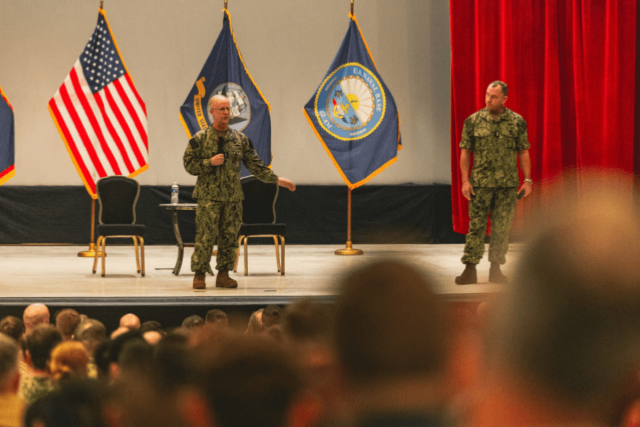
On 24 November 2025, during a visit to U.S. naval installations in Guam, Admiral Daryl Caudle, Chief of Naval Operations, delivered one of the most direct readiness messages to date: the Navy must be ready now for high-intensity conflict, not just plan for it in the future.
The Message and the Setting
Guam is one of the most strategically important forward bases for the U.S. Navy in the Western Pacific. Admiral Caudle’s choice of venue underscored the operational shift: forward stations must serve not only as support hubs, but as key nodes of continuous readiness. He referenced a notional 2027 timeframe for being fully prepared for protracted Pacific conflict, but stressed that the buildup must occur immediately—not gradually.
Key Tenets of Readiness
- Personnel and platforms: Sailors, ships, air assets and logistics must all reach higher tempo and standards. Routine deployment cycles are inadequate for the contest ahead.
- Integration and allied engagement: Readiness includes interoperability with regional allies, quicker surge capability, and multi-domain operations (surface, subsurface, air, space, cyber).
- Mindset shift: The Navy must transition from presence to persistent high-end capability. Risks accepted must reflect the strategic environment—not the comforts of peacetime.
- Forward-based realism: The deployment posture at Guam and other forward stations must support sustained operations in contested environments—not just fleeting transits.
Relevance for the Veteran Community
For veterans who stood watches in forward areas, who understood the latent tension of deterrence missions, Admiral Caudle’s message resonates deeply. It affirms that the mission of readiness does not pause for peacetime—it evolves in every decade, with new tools, new geography, but the same underlying demand: readiness, integrity, and capability.
This address also echoes the legacy of the CVB readership: when the world counted on those ready, you answered. Today’s Sailors are called to the same standards. Your service, sacrifice and vigilance remain the foundation upon which they build.
Discover more from CONNECTICUT VETERANS BULLETIN
Subscribe to get the latest posts sent to your email.
