January 2, 2026
As the new year begins, the Connecticut Veterans Bulletin stands firmly with the men and women of the United States Armed Forces deployed across the globe — and with the families who shoulder the weight of that service every single day.
RED FRIDAY is more than a reminder. It is a commitment: to remember those currently serving, to acknowledge the sacrifices that rarely make headlines, and to honor the quiet strength of spouses, children, and loved ones waiting at home.
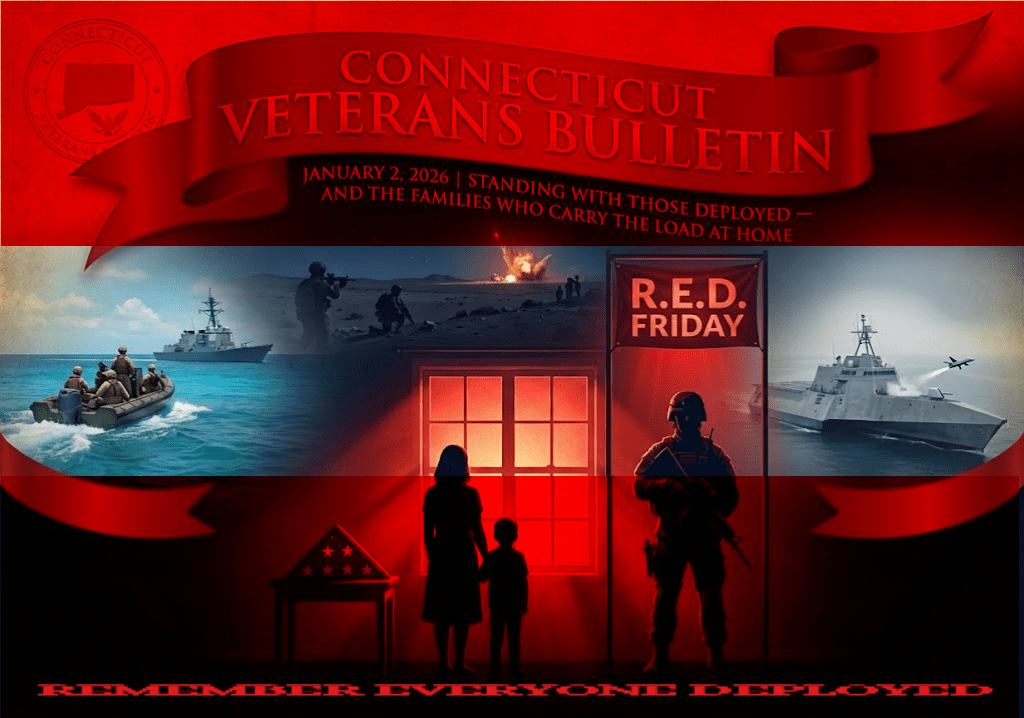
This edition brings attention to three significant and verified military developments from the final days of December — each reflecting readiness, resolve, and the evolving nature of modern warfare. From Marines training in maritime interdiction operations in the Caribbean, to U.S. forces striking Islamic State remnants in Syria, to a historic naval milestone in unmanned warfare in the Arabian Gulf, these stories underscore the vigilance required to protect global stability.
🇺🇸 U.S. Marines With 22nd Marine Expeditionary Unit (SOC) Conduct Maritime Interception Operations Training

December 30, 2025
U.S. Marines assigned to the 22nd Marine Expeditionary Unit (Special Operations Capable) conducted maritime interception operations (MIO) training while deployed to the U.S. Southern Command (USSOUTHCOM) area of responsibility in late December.
Operating in the Caribbean Sea aboard amphibious shipping with the Iwo Jima Amphibious Ready Group, Marines and Sailors rehearsed vessel interdiction scenarios designed to strengthen sea-based security and counter illicit maritime activity.
Maritime interception operations are a critical capability within USSOUTHCOM’s mission set. The region’s expansive maritime routes are frequently exploited by transnational criminal organizations involved in narcotics trafficking, weapons smuggling, and human exploitation. These exercises reinforce the ability of Marine forces to rapidly respond, board, search, and secure vessels while maintaining strict rules of engagement and force protection.
The 22nd MEU (SOC) is built around a Marine Air-Ground Task Force, composed of:
- Battalion Landing Team 3/6, serving as the ground combat element
- An aviation combat element providing rotary-wing and tilt-rotor support
- A logistics combat element sustaining extended sea-based operations
- A Maritime Special Purpose Force, trained for specialized boarding and interdiction missions
During the training evolution, Marines conducted high-speed approaches using small boats, coordinated communications with shipboard command centers, practiced controlled entries, and executed scenario-based boardings designed to replicate real-world threats.
Though routine in appearance, these operations represent constant preparation for crises that can emerge without warning. The professionalism displayed during these maritime drills reflects a force that remains ready to act decisively — anywhere, anytime — in defense of regional security and U.S. interests.
🇺🇸 U.S. and Partner Forces Kill or Capture Nearly 25 Islamic State Operatives in Syria

December 30, 2025
U.S. Central Command confirmed that U.S. and partner forces conducted a series of coordinated operations across Syria, resulting in the death of at least seven Islamic State fighters and the capture of nearly two dozen additional operatives during the latter half of December.
Between December 20 and December 29, joint forces executed 11 targeted missions aimed at dismantling ISIS cells, eliminating leadership elements, and disrupting weapons and logistics networks. These actions included the destruction of four confirmed ISIS weapons caches, significantly degrading the group’s ability to conduct future attacks.
These missions followed Operation Hawkeye Strike, launched on December 19 in response to a deadly ambush near Palmyra earlier in the month. That attack claimed the lives of two U.S. Soldiers from the Iowa National Guard and an American civilian interpreter — marking the first U.S. combat deaths in Syria since the overthrow of the Assad regime in 2024.
The operations combined intelligence-driven targeting, partnered ground maneuver, and precision engagement to prevent ISIS from regenerating in ungoverned spaces. While the organization no longer controls significant territory, its remnants remain capable of conducting lethal attacks, necessitating sustained pressure.
U.S. officials reiterated that these missions are part of a long-term commitment to prevent ISIS from re-establishing operational networks that threaten regional stability and international security.
The actions taken in Syria reflect a broader message: attacks against U.S. personnel and partners will be met with focused, disciplined, and decisive force — carried out by professionals honoring those lost by continuing the mission.
🇺🇸 U.S. Navy Launches Attack Drone From Independence-Class Ship in the Arabian Gulf

December 31, 2025
The U.S. Navy achieved a historic milestone in December with the first-ever launch of an attack drone from an Independence-class littoral combat ship at sea.
Operating in the Arabian Gulf, Sailors aboard the USS Santa Barbara (LCS-32) successfully launched a Low-cost Unmanned Combat Attack System (LUCAS) — a one-way, expendable unmanned aerial system designed to strike designated targets with precision.
The launch occurred under the oversight of U.S. Naval Forces Central Command / U.S. Fifth Fleet, as part of Task Force Scorpion Strike, a specialized element focused on rapidly integrating unmanned combat technologies into fleet operations.
LUCAS drones are designed to expand a ship’s offensive reach while remaining cost-effective and adaptable. Capable of being deployed from multiple platforms, these systems provide naval commanders with increased flexibility in contested environments — especially in regions like the Arabian Gulf, where maritime traffic density and strategic chokepoints demand constant vigilance.
The successful launch demonstrated the Navy’s ability to integrate autonomous strike systems directly into surface combatants, marking a significant evolution in maritime warfare. It also underscored the growing role of unmanned platforms as force multipliers that complement traditional manned assets.
This achievement reflects years of experimentation, innovation, and operational testing — and signals a future fleet where human skill and autonomous capability work side by side to deter aggression and protect vital sea lanes.
🇺🇸 RED FRIDAY Reflection
Across three vastly different theaters — Caribbean waters, Syrian deserts, and the Arabian Gulf — America’s service members continue to operate with precision, discipline, and purpose.
To every Marine, Soldier, Sailor, Airman, Guardian, and Coast Guardsman currently deployed — and to the families waiting at home — the Connecticut Veterans Bulletin offers its deepest respect and unwavering support.
Your service does not go unnoticed.
Your sacrifice is not forgotten.
RED FRIDAY stands with you.
Discover more from CONNECTICUT VETERANS BULLETIN
Subscribe to get the latest posts sent to your email.
