This RED FRIDAY on 11 April 2025, we pause to reflect on the strength, resilience, and unwavering commitment of the brave men and women in uniform, as well as the families who support them from home. In the face of evolving global challenges, the troops of today continue to stand strong, defending freedom and ensuring that the ideals of liberty are upheld.
This week’s RED FRIDAY trilogy highlights not only the advancements in our military capabilities but also the personal sacrifices and emotional toll that service members and their families endure daily. From the heart of the Indo-Pacific to the high seas with the commissioning of the USS Iowa, these men and women are making history in critical roles. But equally important are the quiet heroes at home—the spouses, children, and loved ones who shoulder the emotional burdens of military service, often with little recognition.
Strength Through Sacrifice
Every deployment, every mission, and every service member’s call to duty is a testament to the commitment that stretches far beyond the battlefield. For military families, this commitment is often marked by moments of separation, uncertainty, and deep personal sacrifice. Yet, these families persist, knowing that the work of their loved ones helps to safeguard not just national security but the freedoms that all citizens hold dear.
The resilience of military families is a central theme in the RED FRIDAY spirit. It is a reminder that the strength of the armed forces is not only in the hands of those who wear the uniform but also in those who stand beside them, unwavering through the challenges of military life.
Global Impact and Personal Sacrifice
This week’s RED FRIDAY trilogy underscores how our military is not only leading technological advancements but also protecting peace and stability on the world stage. From the commissioning of the USS Iowa to the ongoing developments in the Indo-Pacific, U.S. service members are responding to global threats with courage and determination. But it’s important to remember that behind every mission is a family member waiting for a phone call, a message, or a return home that may not come for months, or even longer.
Families on the Frontlines
The families of deployed service members face their own battles—managing households, careers, and, often, the mental and emotional weight of worry. These families are the unsung heroes of the military community, constantly adapting and standing firm in the face of adversity. Their contributions are just as vital as those of their loved ones in uniform, and the support they offer is invaluable in maintaining morale and strength within the ranks.
Honoring RED FRIDAY
As we commemorate RED FRIDAY on 11 April 2025, we encourage everyone to take a moment to reflect on the personal sacrifices made by service members and their families. Wear red to honor their courage, and remember that behind every uniform is a family who supports them unconditionally.
Let us never forget the strength of those who serve and the families who are there for them every step of the way. As the U.S. military continues to evolve and adapt to global challenges, the commitment of the troops, alongside the steadfastness of their families, remains the backbone of our national security.
On this RED FRIDAY, we honor the dedication, sacrifice, and resilience of all our military families. They are the silent warriors, and their unwavering support ensures that our soldiers remain strong on the front lines, wherever they may be.
Iowa National Guard 113th Cavalry Unit Prepares for Overseas Deployment in 2025
The Iowa National Guard is gearing up for a major deployment of over 1,800 soldiers to the Middle East later this year. This deployment is part of the culmination of the 2nd Brigade Combat Team (BCT), 34th Infantry Division’s readiness cycle, which spans five years. It will see Iowa soldiers involved in Operation Inherent Resolve, a multinational mission aimed at countering the Islamic State (ISIS) and supporting regional stability.
The units involved in this deployment come from various communities across Iowa, including Sioux City, Le Mars, and Storm Lake. Specific units preparing for the mission include Company D of the 334th Brigade Support Battalion from Sioux City, Troop C of the 1-113 Cavalry Regiment from Le Mars, and Company F of the 334th Brigade Support Battalion from Storm Lake. These soldiers will provide critical security operations, including patrolling and site security, alongside partner nations to ensure the region’s stability.
Before deployment, the Iowa National Guard has organized town hall meetings across the state to ensure that families and communities stay informed. These sessions focus on mission objectives, training schedules, and the support systems available to families during the deployment period. Training for this mission is intensive, with a 21-day force-on-force rotation scheduled at the Joint Readiness Training Center at Fort Johnson, Louisiana, set for the summer.
As the deployment date approaches, sendoff ceremonies will be held in several Iowa cities. These events offer a chance for communities to honor the service members before their deployment. The sendoff schedule is as follows:
- Sioux City: May 28 at 3 p.m. at Bishop Heelan High School
- Le Mars: May 28 at 3 p.m. at Le Mars High School
- Spencer and Estherville (joint ceremony): May 29 at 1 p.m. at Estherville Armory
These ceremonies will not only provide soldiers with a moment of recognition but will also emphasize the ongoing bond between the Iowa National Guard and the communities that support them.
Historically, Iowa National Guard units have maintained a strong presence in international operations. For example, in July 2021, soldiers from the 113th Cavalry Regiment returned from a year-long deployment to Kosovo, where they participated in NATO’s Kosovo Force mission. This underscores the Iowa National Guard’s commitment to global operations and regional security.
As this deployment progresses, families, employers, and communities continue to show their unwavering support for the soldiers. The upcoming mission is another step in the Iowa National Guard’s ongoing commitment to ensuring global security and fostering regional partnerships.
U.S. Navy Steps Up Massive Joint War Training in the Pacific for 2025 Indo-Pacific Contingencies
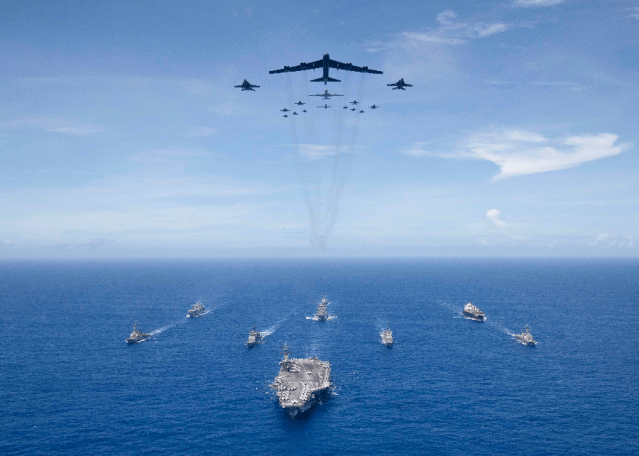
In a significant shift in U.S. military strategy, the Department of Defense is revamping its approach to training for potential future conflicts in the Indo-Pacific region. At the forefront of these changes is the Navy’s push for large-scale, integrated joint war exercises across the Pacific to prepare its forces for a complex conflict scenario against China. This initiative, led by Vice Adm. Michael Boyle, Director of Navy Staff, reflects the Pentagon’s recognition that future wars in the region will demand seamless coordination across all military branches, including the Navy, Air Force, Army, Marines, and Space Force, along with key allies.
A Strategic Shift Toward Joint Training
Historically, military exercises focused on individual services honing their capabilities in isolated environments. However, with China’s growing assertiveness and the increasing importance of the Indo-Pacific, the Pentagon is now shifting towards more joint rehearsals, where multiple services train together, providing a holistic approach to battle readiness. Boyle emphasized that traditional exercises, such as war games and field training, validate concepts and plans but do not fully integrate the services in a combat environment.
“We don’t do rehearsal,” Boyle remarked, acknowledging the limitations of current training. “We need to rehearse as a joint force and figure out what capabilities we will need in the future.”
This initiative aims to address these gaps by pushing forward joint rehearsals with a focus on integrating military branches and aligning them to fight as a cohesive team in large, complex operational environments, particularly in the expansive Indo-Pacific theater.
The Role of Advanced Joint Forces
The concept behind these new drills is to train personnel across different branches at the tactical level to understand the challenges of integrated combat. The Navy’s Fighter Weapons School, the Air Force Weapons School, and Marine Expeditionary Forces from Camp Pendleton are central to these efforts, conducting rehearsals alongside the Space Force and Cyber Command. This cross-branch collaboration is designed to enhance the military’s ability to operate in environments that are technologically sophisticated, heavily contested, and geographically vast.
For example, the joint exercises include real-time assessments of how forces will “sense and make sense” of an ever-evolving battlefield, particularly one where cyber warfare, space-based operations, and traditional air, land, and sea tactics intersect. These exercises are not just about enhancing combat skills but about preparing for the dynamic challenges of future warfare.
Focus on 2040 and Beyond
A critical aspect of this new training initiative is its long-term focus. Boyle discussed how these exercises are not only preparing for conflicts today but also for those that may arise in 2040 or 2050. The goal is to ensure that U.S. forces are not just prepared for immediate threats but are building the technological and strategic capabilities necessary for long-term success in the Pacific theater.
The military’s approach has evolved to anticipate new and emerging threats. According to Boyle, the exercises will incorporate technologies and capabilities expected to be vital in the coming decades, ensuring that U.S. forces remain adaptable and effective against technologically advanced adversaries.
Key Exercises Driving Change
Several high-profile exercises are helping shape this future training paradigm. Among them is the Return of Forces to the Pacific (REFORPAC), a two-week exercise that will take place this summer, focusing on the logistics and operational readiness of the U.S. military in the Indo-Pacific. REFORPAC will see the integration of land, air, and sea forces from both the U.S. and its international allies. This exercise will specifically focus on sustaining operations under attack and ensuring the mobility and logistics of military units throughout the region.
Additionally, exercises like Bamboo Eagle are already testing the U.S. Air Force’s capabilities in large-scale air combat within the Pacific. These exercises, which began in 2024, provide critical insights into air combat strategies and highlight the importance of preparing U.S. and allied forces to fight together in complex, multi-dimensional environments.
Collaborations with Allies
The joint training is not limited to U.S. forces alone. The Rim of the Pacific (RIMPAC) exercise, the world’s largest maritime exercise, is another significant event where the U.S. military works alongside numerous allies, including forces from Japan, Australia, and Canada, among others. In 2024, 29 nations and 40 surface ships participated in this major international maritime exercise, demonstrating the U.S. military’s commitment to strengthening bilateral relationships with key Pacific partners and enhancing interoperability in preparation for a potential conflict.
As the geopolitical situation in the Indo-Pacific becomes more complex, the integration of military forces through these joint exercises will be pivotal in ensuring that the U.S. and its allies remain prepared for any eventuality.
The Indo-Pacific’s Growing Importance
The Indo-Pacific region’s strategic importance continues to grow, driven by China’s expanding military footprint. This evolving situation has led the U.S. military to refocus its resources and training in anticipation of future conflict. The increasing complexity of modern warfare, involving a mix of conventional forces and advanced technologies like cyber warfare and space-based assets, is shaping the way the U.S. military prepares for potential engagements.
The integrated, joint approach to training is a direct response to the need for a well-coordinated force that can operate across vast distances and in contested, multi-domain environments. With China’s military developments and the strategic significance of the region, the Pentagon is prioritizing these new training exercises as part of its broader strategy to maintain a competitive edge.
Looking Ahead
Vice Adm. Boyle’s remarks and the Navy’s vision underscore the importance of adapting U.S. military strategy to the demands of modern warfare in the Indo-Pacific. Through joint rehearsals, large-scale exercises, and collaborations with allies, the U.S. is positioning itself to maintain readiness against a rising threat from China.
As these exercises continue to evolve, the lessons learned will be crucial in shaping the future of military operations in the Indo-Pacific. The goal is clear: a fully integrated, adaptable, and technologically advanced joint force prepared to face the challenges of the 21st century.
U.S. Navy Strengthens Submarine Force with Commissioning of 24th Virginia-Class USS Iowa
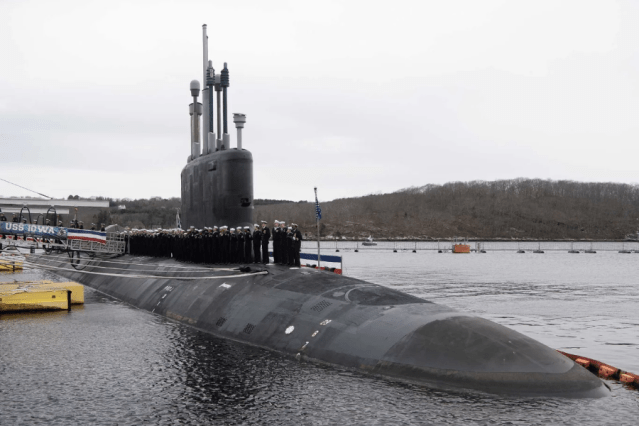
The U.S. Navy has officially commissioned the 24th Virginia-class fast-attack submarine, USS Iowa (SSN 797), on April 5, 2025, at Naval Submarine Base New London in Groton, Connecticut. This milestone marks a significant advancement in the U.S. Navy’s strategic undersea capabilities as global naval powers, particularly China and Russia, continue to enhance their underwater forces.
The Virginia-class submarines, such as the newly commissioned USS Iowa, form the core of America’s modern undersea warfare fleet. At 377 feet in length, capable of speeds exceeding 25 knots submerged, and powered by a nuclear reactor that allows for more than three decades of operation without refueling, the USS Iowa stands as a testament to the U.S. Navy’s focus on technological superiority. Its armament includes 12 vertical launch tubes for Tomahawk cruise missiles, four torpedo tubes for Mk-48 advanced torpedoes, and the capacity to deploy unmanned undersea vehicles and special operations forces.
China has been rapidly expanding its submarine fleet, with over 60 submarines, a dozen of which are nuclear-powered, but it lags behind the U.S. in areas like acoustic stealth and sensor integration. Russia’s smaller, though highly capable, Yasen-class nuclear-powered submarines, such as Kazan and Novosibirsk, remain formidable, armed with advanced cruise missiles like Kalibr and Oniks, and possibly hypersonic weapons in the near future.
The USS Iowa’s commissioning is part of a broader U.S. Navy effort to sustain its undersea dominance, especially amid increasing competition from these naval powers. The USS Iowa, built under Block IV, includes significant improvements designed to reduce the number of major maintenance periods and extend deployment availability.
U.S. Navy officials emphasize the role of such submarines in deterring global aggression and projecting power, ensuring that the U.S. Navy remains unmatched in undersea operations. The Virginia-class submarines, with advanced stealth and multi-mission capabilities, remain critical to maintaining the U.S. Navy’s strategic edge.
Looking ahead, the U.S. Navy plans to expand its fast-attack submarine fleet to at least 66 boats, while advancing the next-generation SSN(X) program, further solidifying its superiority in the undersea domain well into the 2030s.
Discover more from CONNECTICUT VETERANS BULLETIN
Subscribe to get the latest posts sent to your email.
