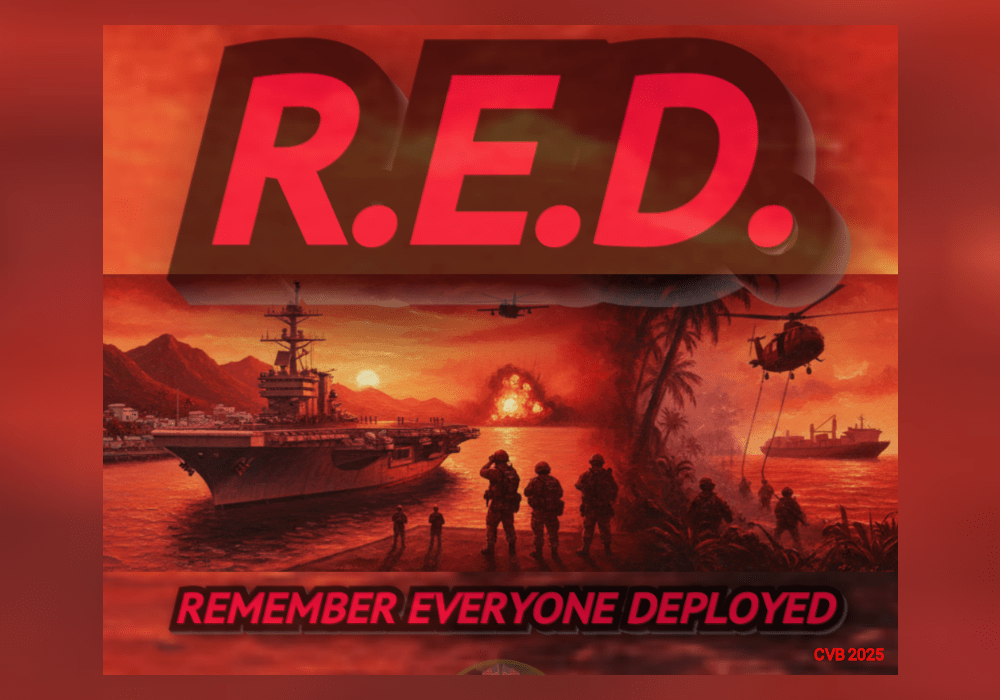
Across three regions the U.S. military remains visibly active and operational — providing deterrence, humanitarian assistance, and partner assurance while forward deployed units sustain a continuous global presence. This week’s CVB RED FRIDAY issue highlights American activity from the Caribbean to East Africa and across the Indo-Pacific, reflecting the breadth of missions that keep allies secure and sea lines of communication open.
In the Caribbean, a large U.S. naval formation remains at sea to counter illicit trafficking and to reassure neighbors. The Gerald R. Ford carrier strike group is operating in the region alongside amphibious forces and additional surface combatants as part of a joint campaign to disrupt trans-regional criminal networks.
In East Africa, U.S. Africa Command is conducting precision strikes in coordination with the Somali Federal Government against al-Shabaab, demonstrating combined operational targeting to degrade extremist capability and protect regional partners.
Across the Middle East, U.S. Central Command forces continue counter-ISIS operations, locating and eliminating weapons caches in southern Syria — actions that demonstrate persistent, theater-level intelligence and strike integration. The guided-missile destroyer USS Mitscher remains deployed to support maritime security in the 5th Fleet area of operations.
In the Indo-Pacific, U.S. Army Pacific units are engaged in multinational exercises and readiness rotations, including JPMRC rotations designed to validate long-range maritime air assault and sustainment operations with partner militaries; the 8th Theater Sustainment Command continues to posture sustainment forces to enable joint operations across the theater.
The U.S. presence in the region is reinforced by Marine Corps Force Design adjustments and rotational logistics initiatives, such as the recent activation of new companies at Camp Schwab in Okinawa to better distribute expeditionary logistics across the first island chain.
At the same time, humanitarian assistance missions continue in the Caribbean following Hurricane Melissa — Joint Task Force elements and embarked Marine Expeditionary Units remain committed to relief and recovery support, while Southern Command forces coordinate aid delivery.
Blue Star families, veterans and deployed personnel share these moments of quiet resolve: the service members on the flight deck, the operators calling in precision effects, the sustainers moving supplies across vast distances. RED FRIDAY recognizes them — their readiness is peace, and their presence overseas is the steadfast guarantee of allied security and humanitarian support.
USS Gerald R. Ford Visits St. Thomas as Carrier Strike Group Operates in Caribbean for R&R and Regional Operations
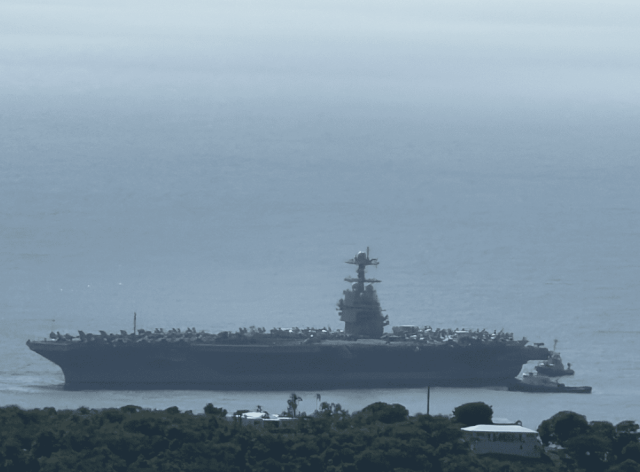
The aircraft carrier USS Gerald R. Ford made a port call at St. Thomas in late November while operating as the centerpiece of a large U.S. maritime task force in the Caribbean, supporting operations to disrupt illicit trafficking and to reassure partners.
The nuclear-powered aircraft carrier USS Gerald R. Ford (CVN-78) arrived at St. Thomas, U.S. Virgin Islands, for a scheduled port visit and R&R following sustained operations in the Caribbean theatre. The visit is part of a wider U.S. maritime posture that has included multiple surface combatants, amphibious units, and aviation assets deployed to the region in recent weeks.
What the deployment is: The Gerald R. Ford leads a carrier strike group that entered the Caribbean in mid-November as part of a joint campaign dubbed Operation Southern Spear, a multi-force effort designed to disrupt trans-regional narcotics trafficking and associated criminal networks. The strike group operates with an embarked carrier air wing that, at times, numbers more than 70 aircraft drawn from East and West Coast squadrons and fleet aviation detachments.
Why St. Thomas matters: The U.S. Virgin Islands sit astride crucial maritime approaches into the eastern Caribbean and provide a secure and forward port for short-term respite, underway replenishment, and community engagements. Port visits such as St. Thomas offer Sailors and aircrew a break from the high-tempo operations while also reinforcing ties with U.S. territories and local authorities. Local leaders welcomed the crew for official events and community outreach during the carrier’s brief stay.
Operational context: The carrier strike group’s presence complements amphibious forces and other surface combatants operating under U.S. Southern Command. Publicly available imagery and reporting show a concentration of U.S. naval power in the Caribbean during late November, including satellite confirmation of the Ford’s position close to the U.S. Virgin Islands. Naval officials emphasize the task force’s focus on maritime domain awareness, interdiction, and partnership operations — while maintaining the carrier’s core mission of high-end air and sea strike capability.
Aircraft and lethality: The embarked air wing provides the Ford with distributed sensors and strike options, including long-range surveillance, strike fighters, and electronic warfare platforms. Carrier sortie generation rates — launches and recoveries practiced daily at sea — enable rapid support to joint and combined partners and provide real-time responsiveness to emerging threats or partner requests for assistance.
Human dimension: For Sailors and Marines aboard strike group ships, the St. Thomas call delivers a measured interval of rest, family connection through mail and video calls, and morale events. For Blue Star families back home, the port call provides a visible reminder that their loved ones are not only forward deployed but also engaged in activities that combine hard power presence with outreach and diplomacy.
Looking ahead: After completing R&R and local engagements, the Gerald R. Ford strike group will resume maritime operations designed to keep sea lanes open and to press the advantage against criminal actors that exploit remote maritime routes — a mission set that increasingly blends counter-narcotics, maritime interdiction and high-end naval presence.
AFRICOM and Somali Forces Conduct Coordinated Strike Against al-Shabaab Near Kismayo, (Nov. 30, 2025)
In coordination with the Federal Government of Somalia, U.S. Africa Command (AFRICOM) struck an al-Shabaab target approximately 114 kilometers southwest of Kismayo on Nov. 30, 2025, part of sustained pressure operations against the extremist group.
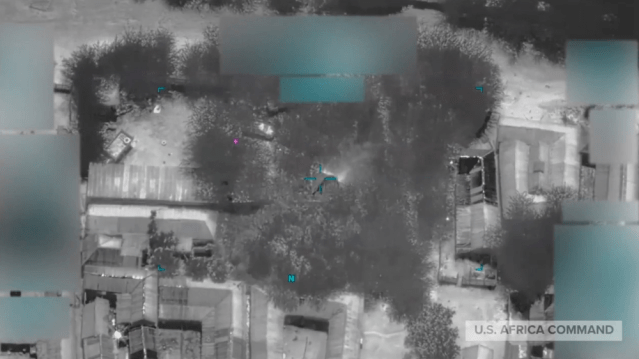
On 30 November 2025, U.S. Africa Command executed a precision airstrike targeting al-Shabaab insurgents and facilities in Somalia, in coordination with the Federal Government of Somalia. AFRICOM reported the strike as part of ongoing operations to degrade extremist capabilities that threaten Somali security and regional stability.
Location and target: AFRICOM’s public statement identifies the strike’s location roughly 114 kilometers southwest of Kismayo — a strategically important area in southern Somalia near littoral supply lines — and indicates coordination with Somali forces to confirm targets and minimize the risk to civilians. AFRICOM routinely cites partner coordination as a key factor in targeting decisions.
Operational purpose and implications: The strike is part of a persistent campaign that combines airpower, special operations, partner-force training, and intelligence support to disrupt al-Shabaab’s command, control and logistics. By targeting leadership nodes, weapons stores and safe havens, AFRICOM seeks to limit the group’s capacity to plan and project attacks, facilitate illicit flows, and influence local governance. These operations also underscore the U.S. approach of enabling partner forces to assume longer-term security responsibilities.
Collateral risk mitigation: AFRICOM statements consistently emphasize steps taken to reduce civilian harm — including pre-strike intelligence vetting, coordination with Somali authorities, and post-strike battle damage assessments. Independent monitoring groups have previously urged continued transparency and verification; AFRICOM’s public releases serve both an operational and informational role for domestic and international audiences.
Wider theater activity: The Somalia airstrike comes amid a pattern of allied and U.S. engagements across the Middle East and Africa aimed at reducing extremist safe havens. These actions are complemented by diplomatic support and stabilization efforts to help local governments restore governance and sustain security gains. AFRICOM’s strikes form one element of the multi-dimensional approach to regional counter-terrorism.
Human element: The operation depends on joint intelligence sharing, remote sensing and partnered liaison, and reflects the day-to-day coordination between U.S. and Somali security services. For U.S. aviators and support personnel executing these missions, the work is highly technical and governed by strict rules of engagement and legal oversight. For Somalis and local partners, these strikes are measured against their immediate protection priorities and the need to stabilize affected communities.
U.S. Army Pacific and 8th Theater Sustainment Command Lead Indo-Pacific Land Readiness with JPMRC Exercises and Theater Sustainment Posture (Nov. 30, 2025)
At month’s end U.S. Army Pacific (USARPAC) and the 8th Theater Sustainment Command (8th TSC) are conducting theater-scale sustainment and multinational readiness operations — reaffirming Army land power as the principal ground component across the Indo-Pacific.
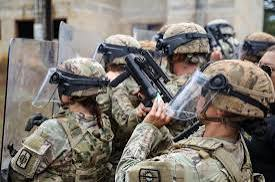
On 30 November 2025, U.S. Army Pacific (USARPAC) and the 8th Theater Sustainment Command marked the culmination of a month of readiness activity that affirmed Army landpower’s role in the Indo-Pacific. U.S. public affairs posts and USARPAC reporting highlighted JPMRC rotations, unit activations and sustainment exercises that together underscored the theater army’s ability to operate across vast maritime and archipelagic terrain.
Joint Pacific Multinational Readiness Center (JPMRC) rotation: From early to mid-November, USARPAC conducted JPMRC Rotation 26-01 around the Hawaiian island chain — a deliberate, multi-domain exercise integrating long-range maritime air assault, unmanned systems reconnaissance, joint sustainment and combined arms maneuvers. Units involved included elements of the 25th Infantry Division, 7th Infantry Division task forces, and sustainment assets coordinated by the 8th TSC. The rotation validated logistics corridors, sea-based distribution concepts, and cross-domain command and control in archipelagic conditions.
8th Theater Sustainment Command’s role: The 8th TSC provides operational-level sustainment for Army and joint forces across USINDOPACOM, enabling operations from forward logistics nodes to port-to-objective resupply. Their public mission statement and operational reporting emphasize the unit’s capability to integrate, synchronize and deliver sustainment that enables long-range combat power — a critical function in the Indo-Pacific’s dispersed geography.
Unit activations & force posture enhancements: USARPAC announced activations and capability investments during November — including information advantage detachments and theater information units designed to improve the Army’s decision advantage in contested environments. These structural changes — coupled with exercise experience — help the theater army operate at range, coordinate allied logistics, and support partners in crisis.
Operational lessons & partner integration: JPMRC rotations tested maritime-land integration: helicopter maritime assault, over-the-horizon logistics, rapid port clearance, and sustainment under contested access. Exercises included multinational partners to validate interoperability, information sharing, and the sustainment pipeline required to keep mobile land elements fighting in dispersed island chains. These lessons reinforce why U.S. Army Pacific is described in public messaging as the dominant land force in the region — an operational truth based on capability, posture, and sustained partnership activity.
What this means for deterrence and crisis response: By emphasizing long-range sustainment and integrated multinational training, USARPAC and 8th TSC are tailoring Army concepts to the Indo-Pacific strategic environment: a theater where reach, distribution and partner networks determine whether forces can hold, surge, or withdraw under pressure. The combined result is a land component that is more expeditionary, networked, and logistically resilient than in previous decades.
Human & family dimension: Soldiers and sustainers who conducted JPMRC rotations deploy and train forward with time away from families — their work, however, underpins every joint readiness posture in the region. For Blue Star families watching for rotations and redeployments, USARPAC’s exercises are tangible signs that America’s theater land forces remain prepared to operate shoulder-to-shoulder with allies across the Indo-Pacific.
Discover more from CONNECTICUT VETERANS BULLETIN
Subscribe to get the latest posts sent to your email.
