John Allan Chapman was born July 14, 1965, in Springfield, Massachusetts, to Eugene and Terry Chapman, and raised in Windsor Locks, Connecticut with his siblings — a brother Kevin and sisters Lori and Tammy — in a home and community that nurtured his sense of duty, compassion, and resolve. From an early age, he excelled both academically and athletically, earning a place on the varsity soccer team as a freshman and establishing state-record diving performances during his time at Windsor Locks High School, from which he graduated in 1983.
Following high school, Chapman briefly attended the University of Connecticut, where he pursued his education while continuing to develop personally. In 1985, he enlisted in the United States Air Force, initially serving as an Information Systems Operator. Though skilled in that role, he was driven to do more. In 1989, Chapman volunteered and retrained as a Combat Controller, a demanding path that required mastery of reconnaissance, air traffic control integration, precision strike support, and battlefield coordination. His training included some of the most rigorous courses in military service, and he emerged as an expert static-line and military free-fall jumper, combat diver, and jumpmaster/dive supervisor.
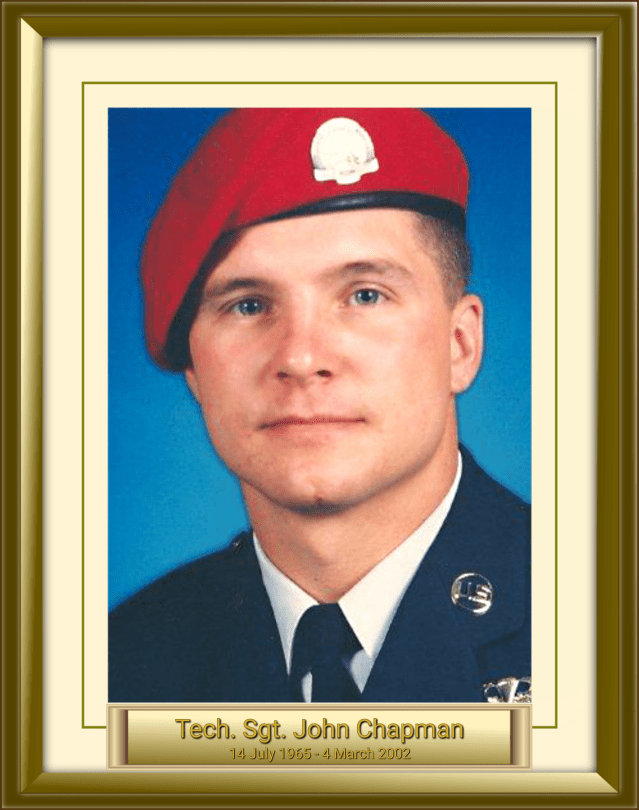
14 July 1965 – 4 March 2002
Chapman’s career saw a breadth of assignments that included the 1987th Information Systems Squadron at Lowry AFB, Colorado, the 1721st Combat Control Squadron at Pope AFB, North Carolina, and the 320th Special Tactics Squadron in Okinawa, Japan, before selection for a leadership role with the 24th Special Tactics Squadron. In that unit, he trained and developed other Special Tactics operators, preparing them for combat operations worldwide.
In February 2002, Chapman deployed to Afghanistan as part of a joint special operations team conducting reconnaissance and support missions during Operation Anaconda. On March 4, 2002, a helicopter carrying his team was ambushed on Takur Ghar, a snow-covered peak where enemy forces had established well-entrenched positions. When a member of the team fell from the helicopter during the initial assault, Chapman and others elected to reinsert onto the mountain to recover him. In knee-deep snow and under intense enemy fire, Chapman engaged multiple enemy positions, repeatedly advancing to assault fortified bunkers and suppress hostile fire to protect his teammates. Despite sustaining mortal wounds during an assault on a machine-gun position, he continued to fight and hold ground, enabling the safety and rescue of others. For his actions, which exemplified “conspicuous gallantry and intrepidity at the risk of his life above and beyond the call of duty,” he was originally awarded the Air Force Cross; in 2018, after review of surveillance and battlefield evidence, the award was upgraded to the Medal of Honor and presented posthumously to his widow at the White House. Chapman was also posthumously promoted to Master Sergeant — a rank he had earned in life but did not wear before his death.
Chapman’s heroism holds a unique place in U.S. military history: he is the first Air Force Combat Controller to receive the Medal of Honor and the first Airman awarded the Medal of Honor since the Vietnam War, detailing actions that were captured and verified through advanced surveillance analysis unique in Medal of Honor reviews. His name is permanently inscribed in the Hall of Heroes at the Pentagon, where it stands among the nation’s most revered service members.
Beyond his battlefield valor, Chapman was remembered as a humble, devoted family man. His widow, Valerie Nessel, and their daughters — Madison and Brianna — carry forward his memory, sharing stories of his kindness, leadership, and commitment to helping others. Friends and teammates described him as “team before self,” a principle he lived every day — whether training, leading, or fighting alongside his comrades.
The Windsor Locks community and the nation have honored Chapman through numerous memorials. A permanent Medal of Honor monument was unveiled in Windsor Locks, and a local roadway was renamed TSgt John A. Chapman Way. Windsor Locks High School also dedicated a memorial near its athletic fields, ensuring his legacy remains visible to future generations. Flags across Connecticut and at military installations marked half-staff proclamations upon his death and during commemorations of his service.
Dates
Birth: July 14, 1965 — Springfield, Massachusetts; raised in Windsor Locks, Connecticut
Angelversary: March 4, 2002 — Takur Ghar, Afghanistan
Service & Achievements
United States Air Force Master Sergeant (posthumous)
Combat Controller, Special Tactics Squadron
Deployed in support of Operation Anaconda, Afghanistan
Medal of Honor, Air Force Cross (upgraded), Combat Control expertise, static-line and military free-fall jumper, combat diver, jumpmaster and dive supervisor qualifications; Hall of Heroes inductee
United States Air Force Master Sergeant John A. Chapman’s life and service represent the highest ideals of courage, self-sacrifice, and devotion to others. His legacy continues to inspire Airmen, Special Operations warriors, and all who honor the ultimate sacrifice in defense of freedom.
CONNECTICUT VETERANS BULLETIN’S GALLERY OF VALOR.
Honor & Remember Connecticut’s Fallen Heroes every day.
https://ctvetsbulletin.org/connecticut-veterans-bulletins-gallery-of-valor/

Leave a comment