
Published: Friday, February 20, 2026
RED FRIDAY — Remember Everyone Deployed — remains a disciplined commitment at Connecticut Veterans Bulletin. It is not ceremonial language. It is a standing declaration of support for every American service member operating overseas and every family carrying the weight of that deployment at home.
During the third week of February 2026, U.S. military operations expanded across multiple theaters. American troops arrived in West Africa to begin an enhanced training mission. Additional naval strike power accelerated toward the Middle East. Advanced U.S. Air Force fighters repositioned forward into the U.S. Central Command area of responsibility. Each movement represented months of preparation and immediate operational purpose.
Behind every overseas mission are service members executing orders with precision and professionalism — Soldiers advising partner forces, Sailors standing watch at sea, Airmen sustaining aircraft in forward environments, Marines prepared for rapid response, and Guardians supporting global operations from critical space domains. Their service is constant. RED FRIDAY ensures they are not forgotten.
Families, too, serve. Spouses manage households alone. Children adapt to time zones and countdowns. Parents watch updates carefully. Employers support extended absences. RED FRIDAY centers them all.
This week’s RED FRIDAY edition provides detailed accounts of three significant overseas force movements: the arrival of U.S. troops in Nigeria for advisory support, the surge of a second aircraft carrier strike group toward the Middle East, and the deployment of 18 F-35A Lightning II fighters from the United Kingdom to reinforce regional airpower.
Wherever American forces are forward deployed, CVB’s support remains steadfast.
U.S. Troops Arrive in Nigeria to Expand Security Cooperation and Counter-Extremism Training
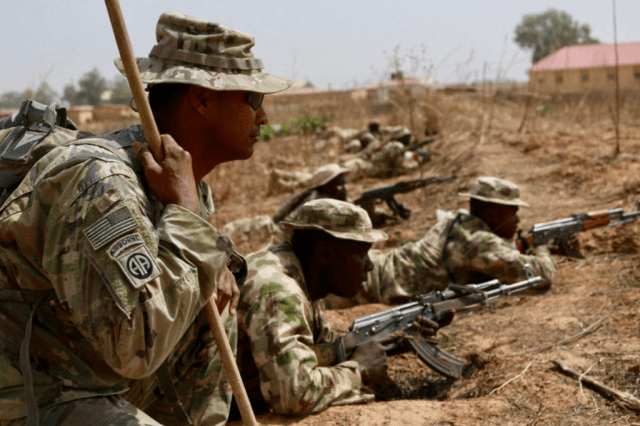
Date of Arrival Announced: February 17, 2026
Approximately 100 U.S. military personnel arrived in Nigeria as part of an expanded advisory and training mission designed to strengthen Nigerian military capabilities against extremist threats. The arrival was publicly acknowledged on February 17, 2026, marking the formal start of the enhanced support phase of the mission.
The deployment centers on non-combat training operations. American personnel are providing instruction in tactical planning, operational coordination, intelligence sharing, communications integration, logistics sustainment, and force protection. U.S. forces are not conducting independent combat patrols; they are operating within an advisory framework under established bilateral security cooperation agreements.
Nigeria continues to confront violent extremist groups operating primarily in its northeastern region. The advisory mission focuses on improving the effectiveness, discipline, and long-term operational sustainability of Nigerian forces engaged in counter-insurgency and counter-terrorism operations.
The deployment required coordinated strategic airlift, secure equipment staging, and synchronized integration with Nigerian defense authorities. Even limited-footprint advisory missions demand comprehensive force protection planning and sustained logistical backing.
Security cooperation missions emphasize host-nation leadership. U.S. advisors support planning and capacity building while Nigerian commanders retain operational authority. This structure reinforces sovereignty while advancing shared regional security goals.
In addition to tactical training, American personnel contribute expertise in intelligence fusion processes and command-and-control reliability, strengthening the institutional capabilities necessary for sustained security improvement.
For the service members involved, the mission represents the disciplined and often understated dimension of global engagement — strengthening allied partners through training, mentorship, and technical precision rather than direct combat operations.
Second U.S. Aircraft Carrier Strike Group Surges Toward Middle East to Reinforce Maritime Deterrence
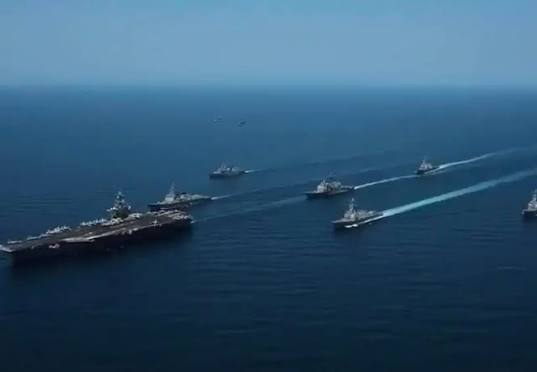
Movement Reported: February 18, 2026
On February 18, 2026, defense reporting confirmed that a second U.S. aircraft carrier strike group accelerated toward the Middle East to reinforce American naval forces already operating in the region. The movement significantly expands maritime deterrence and rapid response capacity.
An aircraft carrier strike group typically includes a nuclear-powered aircraft carrier, guided-missile cruisers, guided-missile destroyers, and an embarked air wing composed of strike fighters, electronic warfare aircraft, airborne early warning systems, and rotary-wing support platforms. The integrated force functions as a mobile sovereign airfield capable of sustained high-tempo operations.
Reinforcing the region with a second carrier increases sortie generation capacity, layered air and missile defense capability, and maritime surveillance coverage. It also strengthens defensive posture around critical sea lanes and regional shipping corridors.
Carrier movement involves complex logistics planning, underway replenishment scheduling, aviation maintenance cycles, and coordinated fleet operations. Thousands of Sailors operate around the clock in engineering spaces, flight decks, combat information centers, medical facilities, and supply departments to maintain readiness.
Naval reinforcement provides scalable response options. Carrier aviation offers rapid reach across broad operational areas without reliance on land-based infrastructure. The flexibility of sea-based airpower remains a central element of American force projection.
Extended sea deployment demands resilience and operational endurance from personnel aboard. High operational tempo, continuous flight operations, and maritime vigilance define life inside a strike group executing forward operations.
The February 18 movement underscored the strategic value of forward-deployed naval forces in maintaining regional stability through presence, capability, and disciplined readiness.
18 F-35A Lightning II Fighters Deploy from RAF Lakenheath to Strengthen Regional Airpower
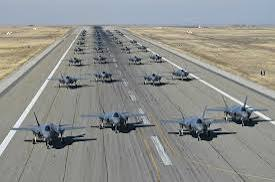
Deployment Date: February 16, 2026
On February 16, 2026, eighteen F-35A Lightning II fighter aircraft deployed from RAF Lakenheath in the United Kingdom to operating locations within or near the Middle East, reinforcing airpower under U.S. Central Command.
The F-35A is a fifth-generation multirole stealth fighter designed for air superiority, precision strike, intelligence integration, and electronic warfare support. Its low observable profile, advanced sensor fusion, and secure data-link architecture allow it to operate effectively in contested environments.
The movement of 18 aircraft represents a significant augmentation of combat air capacity. Strategic air refueling, maintenance teams, weapons specialists, security forces, and logistical support personnel accompanied the deployment to ensure operational sustainability upon arrival.
Forward basing reduces response time and increases operational flexibility. The aircraft integrate into an established theater air component composed of intelligence, surveillance, reconnaissance, and mobility assets, creating a layered and responsive air architecture.
The F-35’s ability to share targeting and situational awareness data across platforms enhances joint force coordination. Sensor fusion allows pilots to maintain comprehensive battlespace awareness while operating in complex threat environments.
Sustaining fifth-generation aircraft overseas requires disciplined maintenance cycles and technical precision. Hundreds of Airmen support sortie generation, avionics reliability, engine performance, and weapons loading operations around the clock.
The February 16 deployment demonstrated the rapid global mobility of American airpower and reinforced the strategic importance of forward-positioned, technologically advanced fighter capability.
