Each Friday, the Connecticut Veterans Bulletin honors those serving far from home under the banner of RED Friday — Remember Everyone Deployed. Today’s stories reflect not only the might and innovation of America’s military forces but the heart of service that connects every branch, every family, and every community.
From the Connecticut National Guard soldiers lifting off from Bradley International Airport, to the USS George Washington sailing alongside allies in the Pacific, and the U.S. Navy’s cutting-edge autonomous vessels tested in NATO’s waters off Portugal — these missions share a common thread of service, duty, and unity.
Behind every deployment stands the unwavering strength of Blue Star families, whose sacrifice reminds us that service is never carried alone. Their resilience embodies the very soul of RED Friday — a weekly reflection of national gratitude for those in uniform and those who support them.
As the world evolves, so too does America’s defense. Yet the promise remains unchanged: those who serve, serve for all of us. The Connecticut Veterans Bulletin salutes them, their families, and the generations that continue to defend freedom — abroad, at sea, and in the hearts of those who wait for their safe return.
U.S. Ship Joins NATO Baltic Sentry to Safeguard Undersea Infrastructure
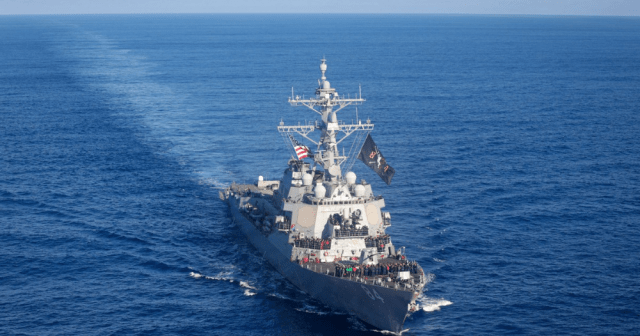
Baltic Sea / NATO Region — early October 2025. For the first time, a U.S. Navy destroyer, USS Bulkeley (DDG-84), joins NATO’s Baltic Sentry mission to help protect critical undersea infrastructure from sabotage. This marks a new level of U.S. commitment to maritime security in Northern Europe and expands the alliance’s capability to deter hybrid threats to cables, pipelines, and seabed systems.
The Baltic Sentry mission, launched earlier in 2025, had previously relied largely on maritime patrol aircraft, surveillance assets, and allied ships. Bulkeley’s integration brings forward-deployed U.S. surface capability to the mission — allowing more persistent presence, quicker response to anomalies, and direct coordination with allied naval forces.
Capabilities & Role of the USS Bulkeley
As an Arleigh Burke-class guided-missile destroyer, Bulkeley adds robust sensors, strike capability, and flexible maneuver to the mission. The ship can assist in detecting undersea drones or intrusion assets, coordinate with acoustic networks, and provide deterrent presence in contested waters. The addition of Bulkeley signals that the Baltic Sentry mission is evolving from surveillance to more active maritime assurance.
While the ship is not firing weapons in the mission, it serves as a deterrence node: its presence complicates potential saboteur planning and gives NATO a higher posture in protecting sensitive undersea systems.
Strategic Importance
Undersea infrastructure — cables carrying communications, pipelines carrying energy — is a growing target in modern hybrid warfare. Disruption of these systems can cause cascading effects on communications, finance, energy, and security. By bringing Bulkeley into the mission, NATO and the U.S. underscore how critical it is to defend these unseen lifelines.
The Baltic region, with its narrow seas, dense shipping patterns, and proximity to potential adversaries, is uniquely vulnerable to subaqueous sabotage. Baltic Sentry with U.S. destroyer support helps close gaps in monitoring and mandates a more continuous presence.
Impact on Crews and Partners
For the sailors aboard Bulkeley, participation in this mission means extended time at sea, high vigilance, complex coordination with allied navies, and readiness to adapt from surveillance tasks to more dynamic situational response. While not engaged in high-intensity combat, their role is essential: they are the maritime “eyes and arms” of deterrence.
Allied navies participating in Baltic Sentry gain from U.S. surface presence, data-sharing, tactical interoperability, and the capability to stabilize response in case of a detected threat.
Hundreds of Connecticut National Guard Soldiers Depart from Bradley International Airport
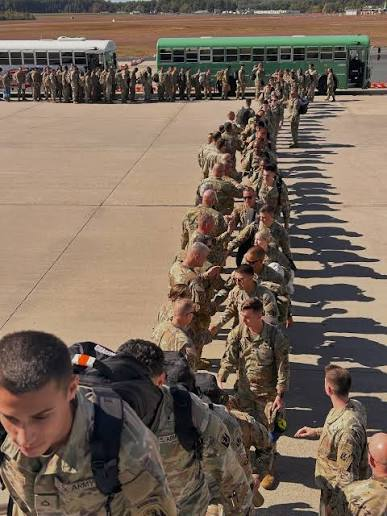
Hundreds of Connecticut National Guard soldiers departed from Bradley International Airport last Friday, marking one of the state’s largest overseas mobilizations in recent years. Family members, fellow service personnel, and state officials gathered to wish them well as they embarked on their deployment.
The deploying troops are part of a large-scale rotational mission supporting U.S. and allied operations overseas, focusing on maintaining regional stability and security. While specific deployment locations remain undisclosed for operational security reasons, the Guard confirmed that the soldiers will serve across multiple regions under U.S. Central Command and European Command areas of responsibility.
Major General Francis Evon, the Adjutant General of the Connecticut National Guard, praised the professionalism and readiness of the soldiers, emphasizing their dual role in state and federal service. “These men and women represent the best of Connecticut,” he stated. “They have trained rigorously to carry out their mission abroad and to support our state whenever called upon.”
For many families, the departure was a deeply emotional moment. Blue Star families—those with loved ones deployed overseas—stood together in unity and pride, symbolizing the enduring spirit of those who serve and those who wait at home.
As the aircraft lifted into the morning sky from Bradley, it carried with it not only a contingent of well-trained soldiers but also the hopes of an entire state standing behind them. The deployment underscores the ongoing global commitments of America’s Citizen-Soldiers who balance civilian life with the solemn oath of service.
U.S. Navy Tests Autonomous Vessels in NATO Exercise off Portugal
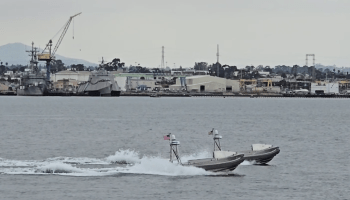
In an important technological milestone, the U.S. Navy tested multiple unmanned surface vessels (USVs) during NATO’s Dynamic Messenger 2025 exercise off the coast of Portugal earlier this month. The operation showcased the growing role of artificial intelligence and autonomous systems in modern maritime warfare and coalition interoperability.
The U.S. integrated its advanced Ghost Fleet Overlord and GARC-class autonomous vessels into joint operations with manned warships from Portugal, Spain, France, and the United Kingdom. The exercise focused on maritime surveillance, reconnaissance, and data-sharing across multiple command centers, marking a breakthrough in the integration of autonomous systems into fleet operations.
Rear Adm. Michael Brown, who oversaw the U.S. contingent, described the event as “a turning point in maritime operations,” explaining that autonomous vessels extend operational reach while reducing risk to personnel. “They enhance situational awareness, shorten decision timelines, and bring new capabilities to complex missions,” he said.
