
RED Friday, April 18, 2025: U.S. Troops Deployed Around the World, Families Standing Strong at Home
On this RED Friday—Remember Everyone Deployed—we pause to honor all U.S. service members currently serving far from home and the families who carry the weight of their absence with quiet strength and pride. April 18, 2025, brings renewed reminders of our military’s vital role in preserving peace, deterring aggression, and strengthening global alliances.
In South Korea, two U.S. Air Force B-1B Lancer bombers recently joined South Korean F-35A and F-16 fighter jets, along with U.S. Air Force F-16s, in a powerful joint aerial drill. The exercise reinforced the readiness and unity of American and South Korean forces and sent a clear message of deterrence in the region.
Meanwhile, in the Philippines, about 14,000 American and Filipino troops are participating in extensive joint exercises, including live-fire drills. These operations serve not only as a testament to U.S. commitment in the Indo-Pacific but also as a critical reminder of the dangers faced daily by our deployed troops.
In the Middle East, the U.S. Navy has now positioned two aircraft carriers in the region. The USS Carl Vinson joined the USS Harry S. Truman near Yemen as the United States prepares for renewed talks with Iran regarding its rapidly advancing nuclear program. This show of strength backs ongoing diplomatic efforts with a clear commitment to regional stability and global security.
Behind every mission and deployment stands a family—spouses, children, parents, and siblings—who endure long months of worry and waiting. Their sacrifice is deeply felt, and today, as we wear red, we do so in gratitude for both the service members abroad and the loved ones who remain resilient back home.
On this RED Friday, let us all stand together to Remember Everyone Deployed. Wear red. Honor their courage. Support their families.
B-1B Bombers Join U.S.–South Korea Joint Drills Over Korean Peninsula in Show of Strength
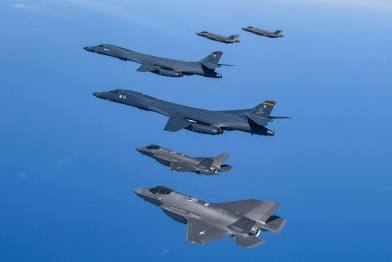
Two U.S. Air Force B-1B Lancer bombers flew over the Korean Peninsula on Tuesday, April 15, 2025, as part of a high-profile joint aerial drill with South Korea. The bombers were accompanied by South Korean F-35A and F-16 fighter jets, along with U.S. Air Force F-16s, in a strategic show of force aimed at deterring threats from North Korea.
The exercise took place at an undisclosed location in South Korea and marked a renewed emphasis on military cooperation between the two allies. The operation was scheduled to align with North Korea’s “Day of the Sun,” a national holiday commemorating the birth of the country’s founding leader, Kim Il Sung. This timing underscored the drill’s message of vigilance and preparedness in the face of continued regional instability.
According to South Korea’s Ministry of National Defense, the joint exercise was designed to bolster combined operational capabilities, demonstrate extended deterrence, and reinforce the readiness of U.S.–ROK combined forces. The B-1B bombers, deployed from Andersen Air Force Base in Guam, executed training alongside allied fighter aircraft in precision strike scenarios, air interdiction missions, and combined air operations.
This marked the second deployment of B-1B bombers to the Korean Peninsula since the beginning of 2025. The United States and South Korea have steadily expanded the scale and frequency of their joint drills in response to North Korea’s evolving missile and nuclear programs.
The latest round of drills comes amid heightened tensions following recent North Korean missile tests and renewed rhetoric from Pyongyang. In February, North Korea launched cruise missiles into the sea following similar joint military exercises by the U.S. and South Korea. Senior North Korean officials, including Kim Yo Jong, sister of Kim Jong Un, condemned the exercises and reaffirmed the regime’s commitment to its nuclear strategy.
Despite North Korea’s objections, U.S. and South Korean officials have reiterated their commitment to strengthening their defense alliance. The presence of strategic assets like the B-1B bombers, capable of carrying large payloads and flying intercontinental missions without refueling, sends a clear message of deterrence.
As both nations continue to navigate an increasingly complex security environment, joint drills such as this one serve not only as a warning to adversaries but also as reassurance to allies throughout the Indo-Pacific region.
U.S. and Philippines Begin Large-Scale Military Exercises to Boost Regional Defense
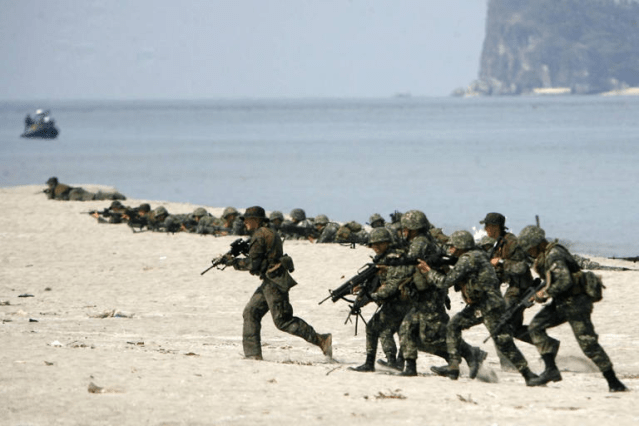
About 14,000 American and Filipino troops are taking part in one of the largest joint military exercises in the region, launched on April 15, 2025. The annual Balikatan drills are set to run from April 21 to May 9 across several key locations in the Philippines. The goal is to strengthen battle readiness, improve joint coordination, and deter aggression in the Indo-Pacific region.
This year’s Balikatan includes around 9,000 U.S. troops and 5,000 personnel from the Armed Forces of the Philippines. Key highlights of the drills include:
- Live-fire exercises: U.S. and Filipino forces will conduct a joint sinking exercise involving a decommissioned ship off the coast of Zambales.
- Missile systems: The U.S. has brought advanced coastal defense systems, including the Typhon and NMESIS missile platforms.
- Amphibious operations: Troops will carry out landing exercises near Palawan and northern Luzon, close to disputed waters in the South China Sea.
- Multinational presence: Military personnel from Australia are participating, and observers from Japan, Poland, and the Czech Republic are also attending.
Though not aimed at any specific country, the drills are widely viewed as a response to increased tensions with China over contested territory in the South China Sea. Philippine defense officials described the activities as a “defense rehearsal,” emphasizing the importance of readiness to protect national sovereignty.
The Balikatan exercises reflect a growing military partnership between the U.S. and the Philippines, reinforcing their shared commitment to peace and security in the region.
Second U.S. Aircraft Carrier Deployed to Middle East as Iran Nuclear Talks Resume
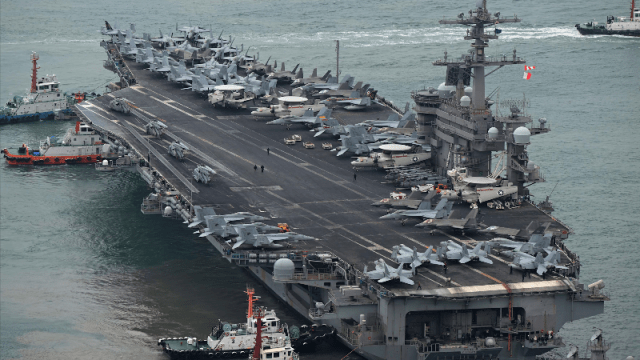
The United States has deployed a second aircraft carrier to the Middle East amid growing tensions with Iran over its nuclear program. On April 15, 2025, the USS Carl Vinson arrived in regional waters, joining the USS Harry S. Truman, already stationed near Yemen. This increased military presence comes just days ahead of a new round of nuclear negotiations between the U.S. and Iran.
The dual-carrier deployment underscores the Biden administration’s approach of combining military deterrence with diplomatic engagement. The carriers are part of broader operations in response to Iranian-backed Houthi rebel activity in Yemen and concerns over Tehran’s accelerating nuclear efforts.
U.S. officials have confirmed that the new round of talks will take place in Muscat, Oman. The location was shifted from Rome after Tehran requested a venue closer to the region. Both sides described preliminary discussions as constructive and positive. Washington is pushing for stricter limits on uranium enrichment and restrictions on Iran’s missile program as part of any renewed deal. Currently, Iran is enriching uranium at 60%, dangerously close to weapons-grade levels.
Iran’s Supreme Leader Ayatollah Ali Khamenei acknowledged the talks but warned against placing too much trust in the U.S. However, Iran’s state-affiliated press hinted at a possible willingness to lower enrichment levels under the right terms.
As diplomatic efforts continue, the presence of two U.S. carriers in the region sends a clear signal: the United States remains committed to regional security while seeking a peaceful resolution to the nuclear standoff
