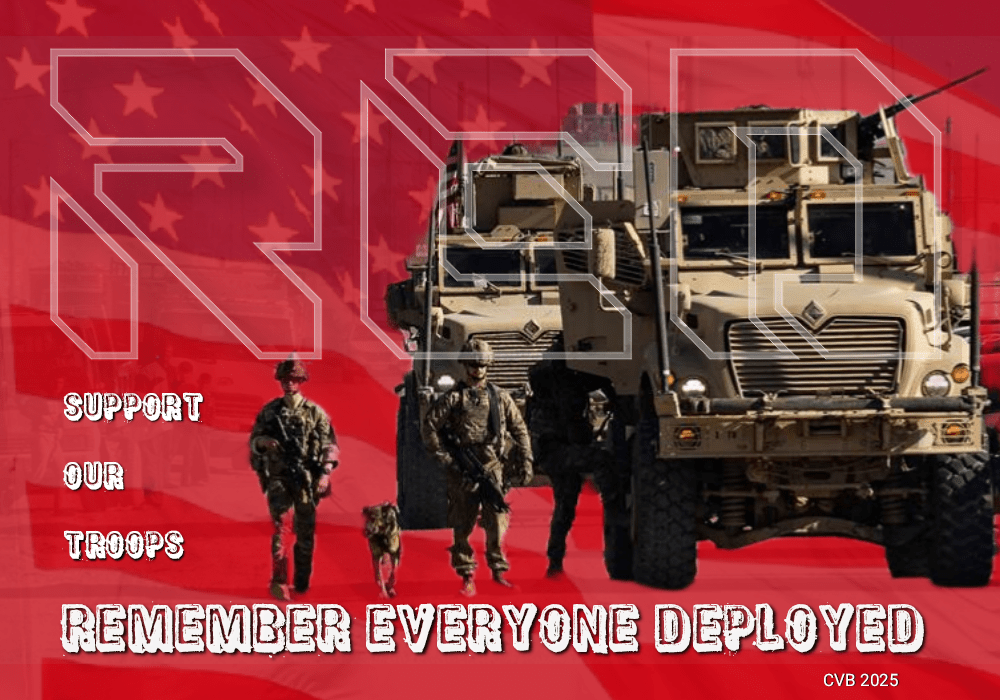
Every RED FRIDAY, we stand united in visible support of our deployed U.S. service members—and the families who bear their absence. As global tensions rise and American military personnel are called once again to the forefront of international defense, our collective gratitude must remain unwavering. This week’s RED FRIDAY publication features three critical developments that reflect the immense responsibility carried by our armed forces around the globe.
First, the USS Nimitz and its strike group surged into the Red Sea in June 2025 as part of a broader U.S. force posture adjustment in response to the growing air war between Israel and Iran. Our featured story, “USS Nimitz Heads to Middle East in June 2025 — Military Focus, Family Impact,” captures both the strategic value of this movement and the human sacrifice that accompanies deployment. Families across America—many right here in Connecticut—continue to wait, worry, and hope as their Sailors and Marines carry out their mission far from home.
Second, we highlight the U.S. Air Force’s decisive mobilization of F-22 Raptors and F-35 Lightning II fighters to the Middle East. Amid increased threats to American forces and allies in the region, this deployment brings cutting-edge airpower to the front lines. The article, “Stealth on Standby: U.S. Deploys F-22s and F-35s Amid Middle East Turmoil,” outlines the scope and scale of this force projection and affirms the dedication of thousands of airmen supporting regional stability at a critical time.
Finally, we take a closer look at South Korea’s upcoming participation in large-scale multinational exercises in Australia. In “South Korean Navy and Marines to Join Large-Scale Multinational Drills in Australia,” we explore how U.S. partnerships across the Indo-Pacific continue to grow. From naval operations to amphibious landings, the United States will stand shoulder-to-shoulder with allies in this rigorous August–September training—ensuring our readiness and deterrence posture remain strong.
Each of these deployments and joint operations represents more than strategy—they represent commitment, courage, and sacrifice. While our military men and women execute missions in distant theaters, we here at home must never forget to wear red, speak their names, and support their families.
This RED FRIDAY, let us renew that commitment. Wherever they serve, we stand with them.
USS Nimitz Heads to Middle East in June 2025 — Military Focus, Family Impact
Deployment Timeline
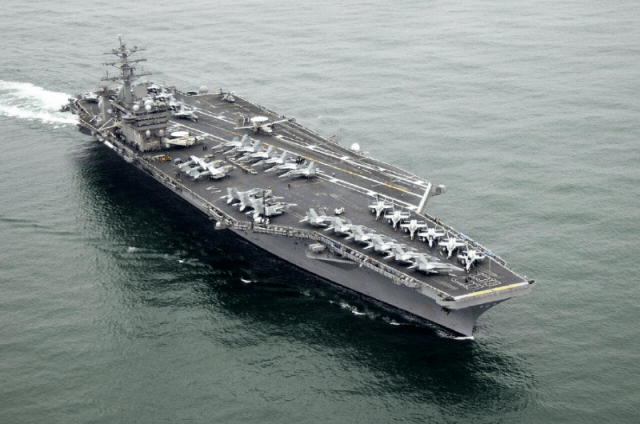
On June 16, 2025, the USS Nimitz Carrier Strike Group (CSG‑11) was redirected from the South China Sea, passing through the Strait of Malacca en route to the U.S. Central Command (CENTCOM) area. The mission was originally a scheduled relief operation for the USS Carl Vinson, but was accelerated due to rising regional tensions.
A planned port visit to Da Nang, Vietnam was canceled, and the strike group proceeded directly toward its new station.
Carrier and Strike Group Details
The deployment includes:
- USS Nimitz (CVN‑68) – a nuclear-powered aircraft carrier
- Carrier Air Wing 17
- Destroyer Squadron 9
- Accompanying escort ships
More than 5,000 sailors are deployed aboard the Nimitz, which supports advanced aircraft including F‑35Cs, Super Hornets, and electronic warfare assets. The carrier functions as a mobile military base, fully equipped for sustained operations without port resupply.
Military Leadership’s Perspective
A U.S. defense official described the movement as part of a planned rotation made more immediate by “recent missile exchanges between Israel and Iran.”
During a May 14 change-of-command ceremony aboard the Nimitz, the new Carrier Strike Group 11 Commander, Rear Adm. Fred Goldhammer, stated:
“The Sailors of Carrier Strike Group Eleven remain the driving force behind our combat readiness, and I look forward to building on their momentum.”
Personal and Family Implications
For Service Members
The abrupt transition from Indo-Pacific operations to Middle East deployment has led to changes in training, operational tempo, and port schedules. Sailors resumed full readiness with little notice, highlighting the unpredictability of global military assignments.
For Families
Families of deployed personnel were informed of the mission shift and are preparing for extended separation. Military family support services have ramped up to assist with childcare, communication logistics, and emotional support. Dependents stationed in overseas locations such as Bahrain have also begun temporary relocations as a precaution.
Strategic Posture
Military officials emphasized that the movement of the USS Nimitz is defensive in nature. It aligns with standard carrier rotation schedules and is not a combat deployment. The presence of two carriers in the CENTCOM area underscores U.S. commitment to regional stability, force protection, and operational readiness.
What’s Next
The USS Nimitz is expected to enter the Arabian Sea or nearby waters shortly, where it will operate alongside the USS Carl Vinson. Families continue to receive updates from the Navy and remain engaged with command ombudsman programs to stay informed.
Summary
The June 2025 deployment of the USS Nimitz is a strategic military operation rooted in preparedness and regional assurance. For thousands of U.S. sailors and their loved ones back home, the mission reflects both dedication to service and the personal sacrifice that comes with answering the nation’s call.
U.S. Air Force Mobilizes F-22s and F-35s as Situation in Middle East Escalates
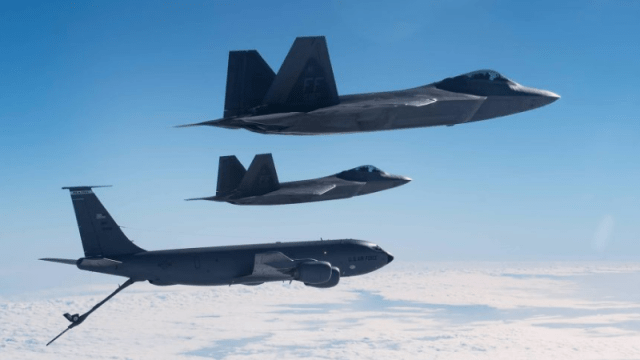
In a decisive move to bolster its defensive posture in the Middle East, the United States Air Force has deployed advanced stealth fighter jets—including F-22 Raptors and F-35 Lightning IIs—as tensions between Israel and Iran continue to intensify. This latest action comes amid a sharp escalation in regional hostilities, with American assets being positioned to deter aggression and protect U.S. forces and interests.
The deployment, ordered by Secretary of Defense Pete Hegseth, includes a significant increase in airpower under U.S. Central Command (CENTCOM). These next-generation fighters are being accompanied by a robust support network of aerial refueling aircraft—KC-135 Stratotankers and KC-46 Pegasus tankers—that began transiting through Europe on June 16, 2025, to assist in the long-range mobilization.
Defense officials have emphasized that this mobilization is strictly defensive in nature. However, the sheer scale of the deployment, which also includes F-16 Fighting Falcons, surveillance assets, and an accompanying U.S. Navy carrier strike group led by the USS Nimitz, underscores the growing urgency of the situation. The Nimitz Strike Group had previously entered the Red Sea earlier this month and is now providing additional air cover and rapid response capability in the region.
“The deployment of F-22s and F-35s gives CENTCOM unmatched capability in responding to aerial threats,” a senior U.S. military officer stated. “These platforms offer stealth, speed, and advanced targeting systems ideal for intercepting drones and ballistic missiles, which remain an increasing threat from both state and non-state actors in the area.”
Israel and Iran have been engaged in a rapidly escalating air war, with both sides exchanging strikes across the region, including Iranian-backed groups in Syria and Iraq. American forces stationed in Iraq, Syria, and Jordan have been placed on heightened alert in recent weeks. The U.S. already maintains a significant footprint in the region, with approximately 40,000 troops deployed across strategic bases in Qatar, Kuwait, Bahrain, and the UAE, among others.
CENTCOM’s forward-deployed assets have already played a key role in intercepting drones and missiles over the past months. With the new wave of stealth aircraft, the U.S. military now expands its options for high-altitude defense and rapid precision strikes, should the need arise.
Military analysts note that the positioning of both the F-22 and F-35 jets sends a clear message to Tehran and its proxy forces. While officials continue to pursue diplomatic de-escalation, this show of force serves as a deterrent against any attempts to target American forces or assets in the region.
As of mid-June, there have been no public indications of direct U.S. involvement in the Israel-Iran air conflict. However, with regional airspace becoming increasingly volatile and threats mounting against key U.S. allies, the Pentagon’s actions highlight a readiness to respond swiftly to any aggression that could spill into a broader conflict.
The coming days are expected to be critical, as all eyes remain on potential retaliatory actions and the possibility of further escalation. For now, the U.S. military’s advanced fighters stand watch—poised to defend, and prepared to strike if necessary.
South Korean Navy and Marines to Join Large-Scale Multinational Drills in Australia
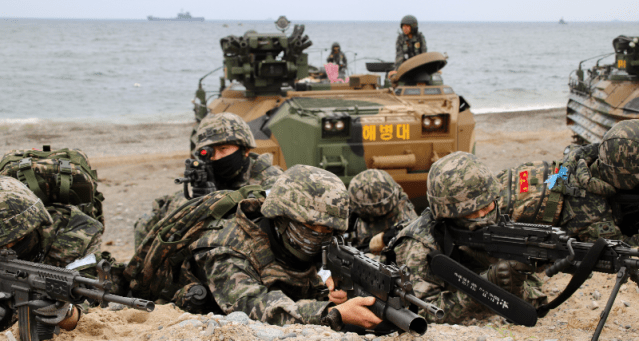
SYDNEY, Australia — In a landmark move reflecting deeper Indo-Pacific security ties, South Korea’s Navy and Marine Corps will join multinational military exercises in Australia this August, expanding Seoul’s contribution to regional defense collaboration. This year’s drills will mark the first time South Korea has deployed both naval and marine elements together for this high-profile annual event.
🌊 Deployment Timeline and Scope
The exercise, scheduled to take place from approximately August 25 to mid-September 2025, will unfold off the coast of northern Australia and involve a coalition of allied and partner forces, including the United States, Japan, and other Indo-Pacific nations.
South Korea’s naval forces last participated in the Australian-led drills in 2021. This year’s return marks their first maritime involvement in four years and introduces a new layer of commitment with the inclusion of the Republic of Korea Marine Corps (ROKMC), which first entered the exercise in a limited capacity in 2023. The 2025 exercise will be their first fully integrated amphibious role alongside coalition forces.
🤝 Strengthening Allied Integration
South Korea’s expanded participation reflects an increasing emphasis on multinational interoperability. The joint presence of ROK Navy warships and ROK Marine ground and amphibious units in the exercise aligns with efforts to strengthen rapid deployment readiness, maritime coordination, and amphibious assault capabilities.
The exercise will feature amphibious landings, combined live-fire events, anti-submarine warfare, and coalition command-and-control drills—scenarios that demand seamless coordination among multinational forces.
🧭 Strategic Significance
South Korea’s growing military involvement in the Indo-Pacific, beyond the Korean Peninsula, signals a broader strategic outlook. By aligning closely with Australia, the U.S., and Japan, Seoul is reinforcing its position as a proactive regional security partner in response to persistent threats from North Korea and wider tensions in the East and South China Seas.
The participation also enhances the operational range and capabilities of South Korean forces, offering practical experience in high-intensity joint operations and reinforcing the shared goal of maintaining a free and open Indo-Pacific.
📜 Regional Defense Commitment
This development continues South Korea’s deepening military cooperation with its Indo-Pacific allies. Since entering the exercise framework in 2021, the ROK military has steadily increased its engagement—reflecting a deliberate policy to expand strategic presence in the region.
For both the ROK Navy and Marine Corps, the 2025 exercise offers more than training—it is a message of resolve, partnership, and regional stability.
