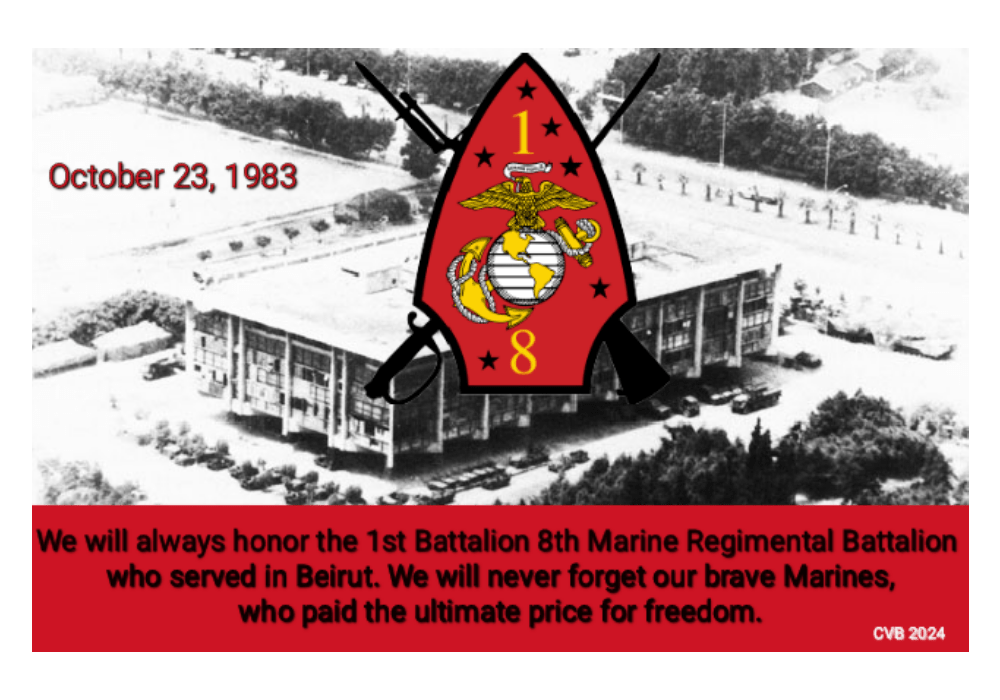

On this day, 41 years ago, our nation was dealt a devastating blow when 241 Americans lost their lives in a tragic and senseless act of terrorism in Beirut, Lebanon. Today, we pause to remember and pay our respects to the Gold Star Families of the 241 fallen heroes and to those who served alongside them.
October 23, 1983, is a day etched in our history as a day of profound sorrow and loss. It was on this fateful day that a suicide truck bomber targeted the building barracks for the 1st Battalion 8th Marines (Battalion Landing Team – BLT 1/8). Among the victims were 220 United States Marines, 18 United States sailors, and 3 United States soldiers, all of whom were peacekeepers on a mission of goodwill and stability.
The toll of this horrific attack was staggering, making it the deadliest single-day death toll for the United States Marine Corps since the iconic Battle of Iwo Jima during World War II. Furthermore, it stood as the deadliest single-day death toll for the entire United States Armed Forces since the first day of the Vietnam War’s Tet Offensive. This tragedy also marked the deadliest single terrorist attack on American citizens before the infamous events of September 11, 2001.
Let us not forget that this act of terror did not only affect American lives. A separate suicide truck bomber targeted French Forces, resulting in a total loss of 307 lives, comprising 305 victims, including 241 U.S. peacekeepers, 58 French peacekeepers, and 6 civilians, in addition to the two suicide bombers.
Today, as we remember the 241 brave souls who made the ultimate sacrifice, we must also honor the resilience and strength of their families who have carried the heavy burden of their loss for 41 years. The pain of that day remains with us, but so does the memory of the courage and dedication of these servicemen and women.
Let us unite in prayer for the Gold Star Families who bear the weight of their loved ones’ absence and for those who served alongside these heroes, for their lives were forever changed by this tragedy. Let us never forget the 241, and let their memory inspire us to work tirelessly for peace and understanding in a world still marred by conflict and hatred.
May the fallen rest in peace, and may their sacrifice serve as a reminder that the pursuit of peace is a noble endeavor worth fighting for, even in the face of great adversity. 🙏🇺🇸 #Remembering241 #BeirutBombing #NeverForget
The Following question was asked;
Why were US Marines in Beirut?
In 1983, U.S. Marines were deployed to Beirut, Lebanon, as part of a multinational peacekeeping force. The mission was aimed at stabilizing the region and helping to restore order during the Lebanese Civil War, a complex and violent conflict involving various factions, including Christian militias, Muslim militias, and foreign interventions by Israel, Syria, and Palestinian groups.
The Marines’ involvement began in 1982, after Israeli forces invaded Lebanon in an effort to expel the Palestine Liberation Organization (PLO), which had been using Lebanon as a base for attacks against Israel. The situation in Lebanon quickly deteriorated, with heavy fighting occurring in and around the capital, Beirut.
To help broker a peace agreement and facilitate the withdrawal of foreign forces, including Israeli and PLO fighters, the United Nations and the United States intervened diplomatically. In August 1982, President Ronald Reagan ordered U.S. Marines to join the Multinational Force (MNF), which also included troops from France, Italy, and the United Kingdom. Their initial mission was to assist in the peaceful evacuation of PLO fighters from Beirut and create a stable environment for the Lebanese government to regain control.
However, the mission expanded as violence continued to escalate, and the Marines remained in Beirut to help support Lebanon’s fragile government and maintain order. Despite their peacekeeping role, the U.S. Marines were caught in the crossfire of Lebanon’s civil war, which involved a complex mix of sectarian tensions, militia rivalries, and foreign interventions.
On October 23, 1983, tragedy struck when a suicide bomber drove a truck loaded with explosives into the U.S. Marine barracks at the Beirut International Airport. The attack killed 241 U.S. service members, including 220 Marines, making it one of the deadliest days in Marine Corps history. A simultaneous attack on French peacekeepers killed 58 soldiers. The bombings were later attributed to Hezbollah, a militant group with backing from Iran and Syria.
The Beirut barracks bombing led to widespread criticism of U.S. involvement in Lebanon, and by early 1984, the U.S. withdrew its forces from the region. The mission, initially intended as a peacekeeping effort, highlighted the complexities and dangers of involvement in volatile conflicts and had lasting impacts on U.S. foreign policy in the Middle East.
