21 April 2025 1445hrs
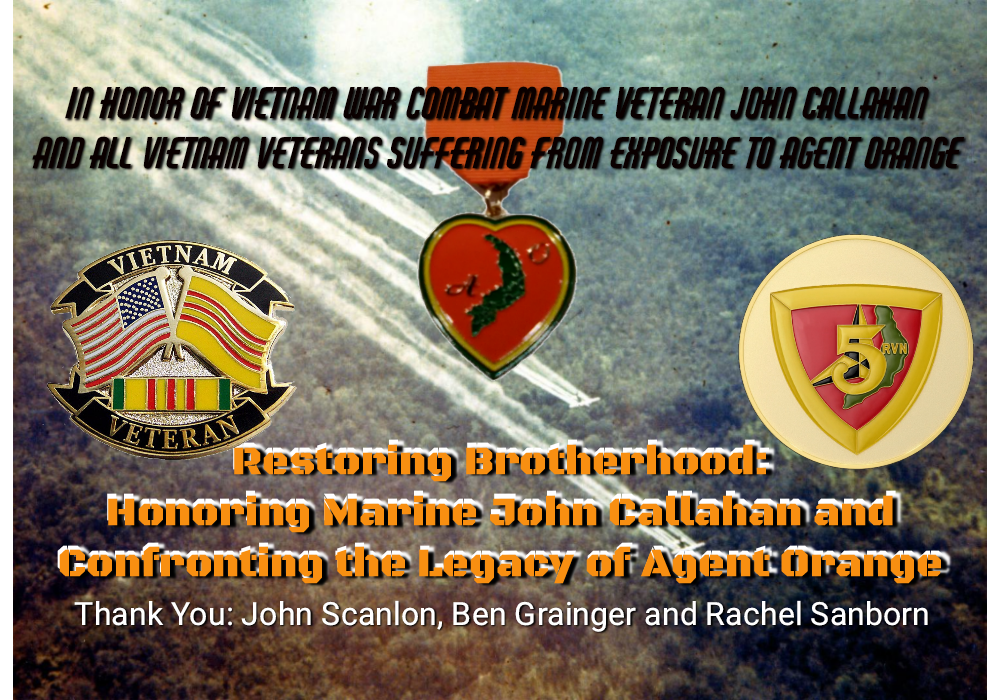
In the quiet halls of Bride Brook Rehabilitation and Nursing Center in Niantic, Connecticut, Marine Corps veteran John Callahan continues to fight a battle that began decades ago in the jungles of Vietnam. A member of the 5th Communications Battalion, 3rd Marine Division, John served with honor during the Vietnam War. Today, he lives with the devastating effects of Agent Orange exposure—a toxic legacy that continues to afflict countless veterans nationwide.
A Symbol of Brotherhood Lost
During a recent hospital stay, John’s personal belongings were mistakenly discarded. Among them was his cherished challenge coin from the 5th Communications Battalion—a powerful symbol of brotherhood, sacrifice, and shared history. That coin, gifted during a rare reunion with his fellow Marines, served as a physical link to the men he served with and those he watched die. Losing it wasn’t just losing a memento—it was losing a part of his story.
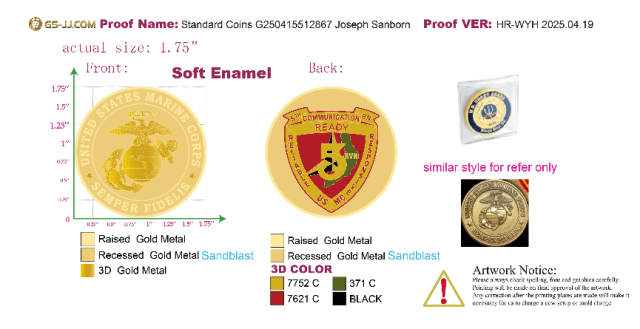
Understanding the emotional weight of that loss, the Connecticut Veterans Bulletin (CVB) launched an effort to replicate the coin. The project quickly gathered support, with contributions from fellow Marines John Scanlon and Ben Granger, and artist Rachel Sanborn of Ryvkah Chaya Art. Their generosity made it possible to order a high-quality replica—crafted not just to match the original, but to reignite the pride and connection it symbolized.
The replica is currently in production. As soon as CVB receives it, they will hand-deliver it to John. This effort was not just about replacing an object. It was about making sure John knows his story still matters, and that his brothers in arms—past and present—are still with him.
John’s Response to the Replica
When John saw the proof of the replica coin, his message to CVB was filled with clarity and emotion:
“It is correct.
It is beautiful. (Really.)Actually, it is—and I’m not trying to take anything from the Original, for that can never be replaced. (Nor should it.)
The history, the memories, the guys I served with (and watched some die)—NOPE, can never replace that.
Yet it’s not meant to replace, but to rekindle that fire of Brotherhood.
The ‘new coin’ represents all the love and feelings, the brotherhood, and the caring about each other.
It makes this ‘new coin’—perhaps it’s not a new coin—
Perhaps it’s a symbol, a little disc, showing that we all care about each other.And that’s what the ‘new coin’ represents to me.
Semper Fi.”
What Was Agent Orange?
Agent Orange was a powerful herbicide used by the U.S. military during the Vietnam War to clear jungle foliage and deny enemy troops cover and food supplies. The chemical was sprayed across Vietnam from 1961 to 1971 during Operation Ranch Hand, with more than 20 million gallons dropped on forests and farmland.
The primary danger came from a contaminant in Agent Orange called dioxin—an incredibly toxic compound that can remain in the environment and the human body for decades. Though the chemical warfare tactics were meant to provide strategic advantage, they left behind a toxic footprint, devastating ecosystems and destroying the health of generations of people.
Human Consequences
Agent Orange exposure has caused a wide range of health issues, including numerous cancers, heart disease, Parkinson’s disease, and diabetes. For many Vietnam veterans like John Callahan, these diseases showed up years or even decades after service—only later traced back to their time in Southeast Asia.
The impact didn’t stop with American troops. In Vietnam, entire communities were affected, and many still suffer today. Children were born with birth defects. Forests were turned into dead zones. Rivers and lakes—once crucial food sources—became contaminated.
For American veterans, the fight didn’t end when they left the battlefield. They had to fight for recognition, for medical care, and for answers. The U.S. Department of Veterans Affairs now lists several conditions as presumptively linked to Agent Orange exposure—but that progress came far too late for many.
The Story of the 5th Communications Battalion, 3rd Marine Division
John Callahan served in one of the Marine Corps’ most vital and unsung units: the 5th Communications Battalion. As part of the 3rd Marine Division, these Marines were responsible for maintaining communication lines—radios, field systems, and secure channels that kept command connected to the front lines.
Their work was invisible to most civilians, but it was essential. Without clear communication, missions could fail. Lives could be lost. Marines like John worked day and night to ensure those lifelines stayed open, often in extreme weather, surrounded by danger, and under threat from the enemy.
They saw it all—and for those who served in the jungles of Vietnam, exposure to Agent Orange was nearly unavoidable.
A National Responsibility
The story of John Callahan is one among thousands. But every individual case is a reminder of the long-term costs of war—costs borne by the men and women who wore the uniform.
As time passes, Vietnam veterans grow older. Many, like John, are in care facilities, facing health issues compounded by chemical exposure. Their stories risk being forgotten unless we actively work to preserve them. Their needs risk being overlooked unless the public continues to speak out.
Every time we honor a veteran, every time we share their story, we make it harder for institutions to ignore them. We send a message that these lives matter. That their service mattered. And that their suffering is not forgotten.
Moving Forward
Thanks to the generosity of a few and the determination of many, one coin is being returned to one Marine. But the deeper mission continues: to ensure that all veterans exposed to Agent Orange receive the recognition, care, and compensation they deserve.
We owe it to John Callahan. We owe it to all who served. And we owe it to every Marine, Soldier, Sailor, and Airman who fought not just in Vietnam—but in the battles that followed long after they returned home.
Semper Fi.
To support veterans like John Callahan or learn more about the impact of Agent Orange, visit ctvetsbulletin.org.
